How to Check a Personal Trainer's Certification Before You Pay
Look for an outside accreditation, confirm it in a registry, and treat any credential you cannot verify as decoration.
 By Imogen Tarrant ·

Verdict first: pick a certification that an outside body has checked, confirm the trainer actually holds it, and ignore any badge you cannot look up. Everything else is marketing. This guide is general information only, not medical, legal or financial advice. A licensed professional, and your own doctor for health questions, should have the final say.
What a personal trainer certification is
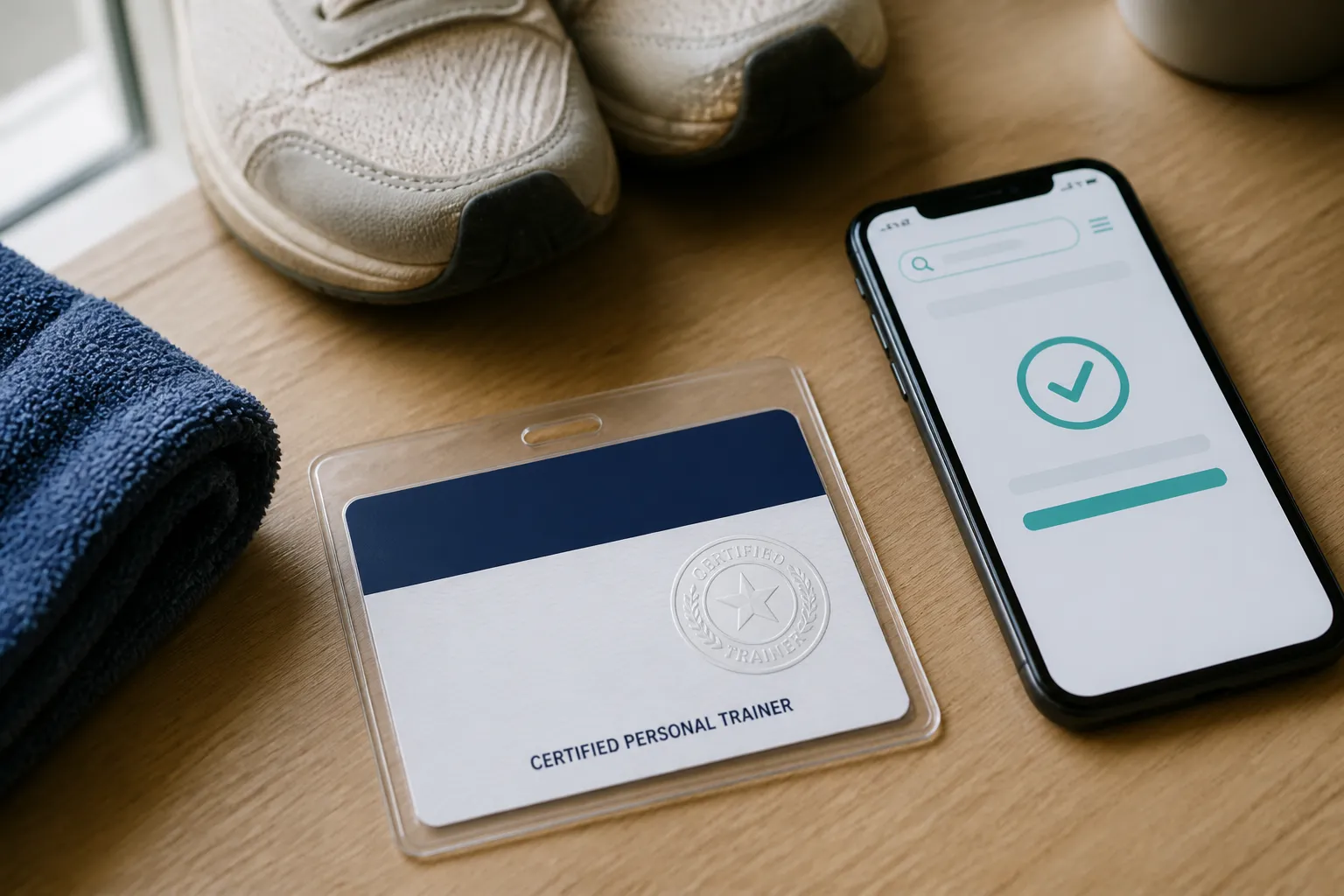
A certification is a credential from a professional organization. It says the holder can design and run exercise programs safely for clients. It is not a government license. Nobody in the sources I reviewed says a state requires one, and none of them says a state does not. So treat the certificate as a signal, and ask what it signals.
Certifications come in two broad kinds: accredited and non-accredited. That split decides how much the paper is worth to an employer. The U.S. Bureau of Labor Statistics keeps an entry for fitness trainers and instructors in its Occupational Outlook Handbook. It is the main federal reference for the job, and a sane place to read what trainers actually do.
Why accreditation matters
Anyone can say their own program is excellent. Accreditation means someone else examined it. In the US, the National Commission for Certifying Agencies (NCCA) is the independent body that checks whether a program meets standards for test development, exam security and ongoing quality assurance. Accredited programs are also reviewed regularly and updated as exercise science changes. A certificate nobody outside the issuer has looked at has none of that behind it.
A second marker is ISO 17024 compliance. The United States Registry of Exercise Professionals (USREPS) says its member certifications are NCCA-accredited or ISO 17024-compliant, and describes them as recognized for exercise professional roles by the U.S. Department of Labor. When comparing options, look for one of those two markers first. If neither is there, ask why.
A caveat worth stating plainly. Much of what is written about certifications comes from the certifying organizations and vendors who sell them. They are not lying, but they are not neutral either. Read their comparison charts the way you read a mattress showroom.
How to check a trainer's credential
Start with the name. A trainer should be able to tell you the credential and the body that issued it without hesitation. Then confirm that body's accreditation on its own site. Several well-known US certifiers are described as NCCA-accredited, but verify the specific credential rather than trusting a logo on a flyer.
Next, use a registry. USREPS runs one for checking the current status of registered exercise professionals and says it verifies more than 130,000 of them. Not appearing there is not proof of incompetence. Plenty of qualified people never registered. It is, though, a reason to ask a follow-up question rather than hand over a deposit.
Non-accredited certifications exist. They can be a starting point, especially in boutique or independent settings. But commercial gyms, hospitals and corporate wellness programs usually want an NCCA credential, so a trainer with only the other kind should be upfront about it. If they are not, that tells you something.
Questions to ask before you hire
Keep them short and expect short answers.
- Which organization issued your certification, and is it NCCA-accredited or ISO 17024-compliant?
- Is it current? What does recertification require?
- Do you have education or experience beyond the certificate?
- Does your credential fit my situation?
Vague answers like "internationally recognized" or "industry standard" are not answers. Name the body or move on. Certifications typically must be renewed through continuing education, so an expired one matters even if the trainer once passed the exam. Credentials also differ in focus. Some are general, others lean toward older adults or specialty populations. Match the focus to your goals. If you have a medical condition, your doctor, not a trainer, decides what exercise is appropriate.
On degrees: one vendor describes its own hiring standard as a degree plus experience. That is one company's rule, not a general requirement. Ask about background, but do not treat a degree as the only proof of skill.
Red flags and what we could not find
Be wary of a low-barrier online course sold as a full certification. Quality varies widely, and reputable employers do not generally accept them as the standard. Be equally wary of any credential that is not NCCA-accredited or ISO 17024-compliant, or that cannot be found in a verification registry.
Now the gaps, because they matter. The sources I used give no current US figures for exam fees, recertification costs or trainer hourly rates. Prices vary by state, city and gym versus independent setting, so get written quotes and compare them. BLS publishes wage data for exercise trainers and group fitness instructors, but I did not have the figures to quote. The sources also do not cover state licensing rules, insurance or liability if a client is injured, or how to file a complaint. For those, check your state's consumer protection office and ask a licensed professional. Ask the trainer about insurance directly, and get the answer in writing.
Sources
- Fitness Trainers and Instructors : Occupational Outlook Handbook: : U.S. Bureau of Labor Statistics
- Exercise Trainers and Group Fitness Instructors
- Home
- NCCA Certifications for the Fitness Industry
- What Personal Trainer Certifications Exist? A Complete 2026 Comparison
- Personal Trainer Certifications Explained: NASM, ACE, NSCA, and ACSM Compared (2026) - 21 minutes
- The United States Registry of Exercise Professionals
- Who We Are | The United States Registry of Exercise Professionals
Still have a question?
Related guides
-

What the PMP Actually Costs, Once You Stop Reading Only the Exam Fee
The headline price leaves out membership, the 35 required training hours, study materials, retakes, and renewal, so budget for the full cycle before you register. By Dolores Kinnane
-

Try the Free Office First: What American Job Centers Actually Offer
Before paying for resume help or career coaching, check what the public workforce network already provides at no cost, and how to confirm a provider is legitimate.By Dolores Kinnane
-

Income Share Agreements: A Loan by Any Other Name
Federal regulators classify most ISAs as private education loans, so the finance charges, repayment terms and placement claims deserve the same scrutiny you would give any loan.By Dolores Kinnane