Before You Pay for a Microcredential, Make Someone Outside the Seller Vouch for It
Most online certificates are worth the money only if you can name what they prove, confirm who reviewed them, and find an outsider who will accept them.
 By AnselmRoarke ·
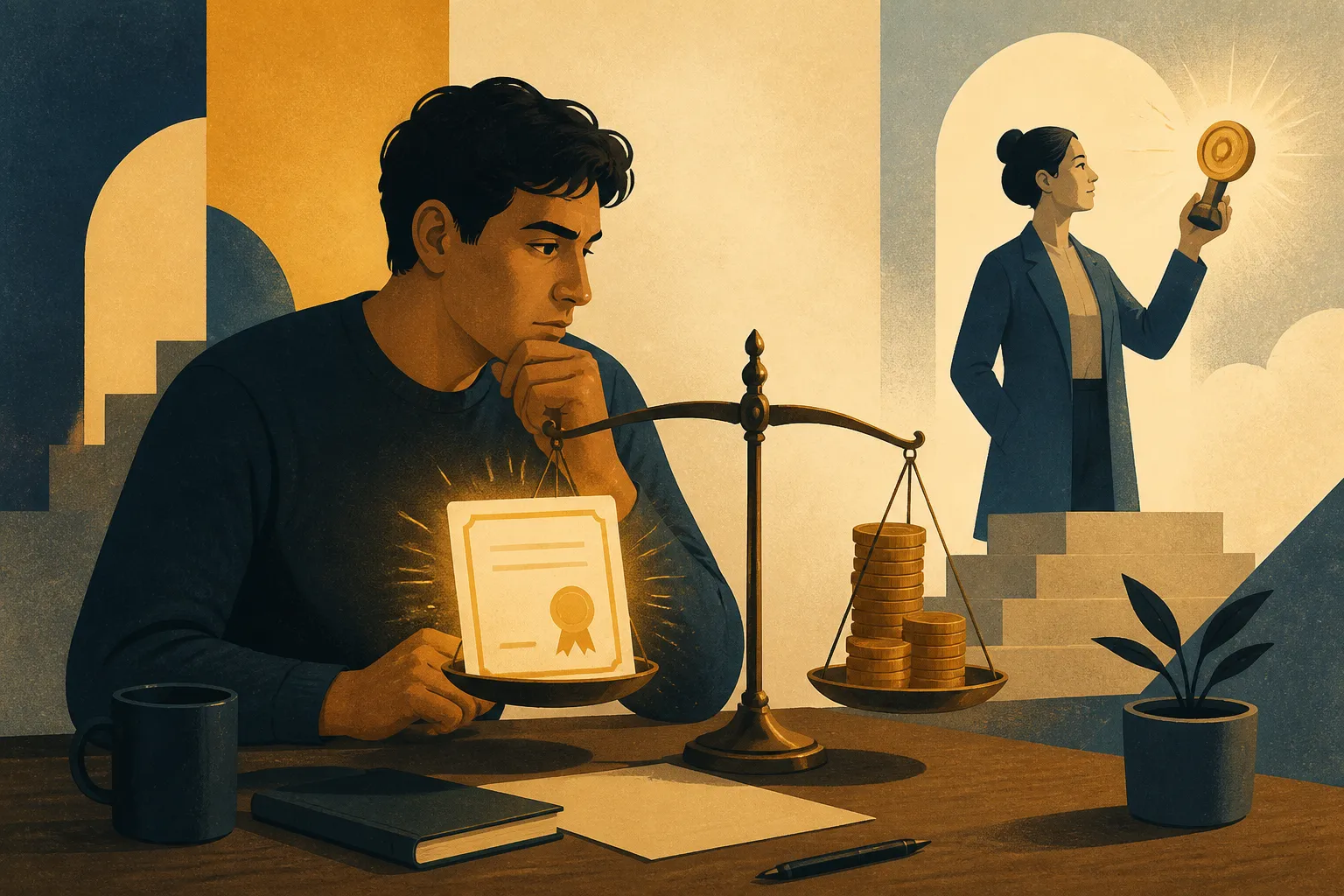
Verdict first: most online courses and microcredentials are worth paying for only if you can name the one thing they prove, show who checked the course, and find someone outside the seller who will accept the result. If you cannot do all three, keep your money. This is general information, not personal financial, legal or career advice, and a licensed professional or the employers you are targeting should have the last word.
What a microcredential actually certifies
A microcredential certifies the learning outcomes of a short learning experience, like a short course or a training. It is meant to show you can do a specific, narrow set of things. It is not a degree in miniature, whatever the brochure implies.
So ask the first blunt question: what exactly does this prove? "Career-ready skills" is not an answer. It is a slogan, and you cannot measure a slogan. A real answer names the outcome and says how you will be assessed on it. A quiz you can retake until you pass is a different product from a graded project reviewed by a person.
Providers range from universities and training institutions to private companies. Do not let the logo settle anything. A private company can build a tight, well-assessed credential. A famous institution can sell a flimsy one. Judge the specific offering.
The European Union's 2022 Council Recommendation is a handy yardstick even if you live in Ohio. It lays out a definition, standard elements for describing a microcredential, and principles for designing and issuing one. A provider that cannot describe its credential in those plain terms has told you something.
How to check quality before you pay
Independent review beats self-praise. Quality Matters, or QM, runs a peer review process that certifies the quality of online and blended courses. It says meeting its standards at or above the 85% level is key to certification, and it updates its rubrics as new research arrives. Anyone can print "high quality" on a landing page. Few can point to a review process with a published threshold.
Now cross-examine the review itself. Does it cover the kind of course you are buying? QM also publishes a separate rubric for continuing and professional education: instructor-led, mentored or self-paced courses that end in pass/fail or skills-based completion rather than academic credit. A badge earned by a college course does not automatically transfer to a short self-paced one. Version and scope matter. QM's higher education rubric was updated in July 2023 to address belonging and inclusion and to reach continuing education and synchronous courses.
You do not need to be an instructional designer to borrow the framework. QM organizes quality around eight standards:
- Course overview
- Learning objectives
- Assessment
- Instructional materials
- Activities and interaction
- Course technology
- Learner support
- Accessibility and usability
Turn those into questions. Are the objectives stated plainly? Do the assessments actually test them? Is there a human when you get stuck? Can people with different needs use the course? Weak answers to any of these are worth knowing before the card comes out.

Whether the credential will be recognized and portable
A credential is worth what the next person will accept. The EU framework treats recognition and portability as key requirements and says that without common standards for quality, transparency, comparability and recognition, microcredentials cannot reach their full potential. Translation: a certificate nobody else honors is a receipt.
So ask who recognizes it. Employers in your field, a licensing body, another school? Can a third party verify it? Get the answer from them, not from the seller. A short email to a hiring manager or a professional association takes ten minutes and may save you hundreds of dollars or more.
Watch how the issuer separates the credential from a degree. DIGITALEUROPE, an industry association, calls for a clear definition, minimum objectivity and standardization of the certified skill, and a clear line between degrees and microcredential certificates. If an offer seems built to be mistaken for a degree, that is not an accident.
The same group proposes an EU register of trusted issuers. The sources behind this guide describe no single US equivalent. That leaves the work to you: check the issuer's standing directly, through its own records, completer reviews and the review bodies above. Confirm US accreditation and state licensing questions with the relevant state agency or professional body.
What it costs, and the red flags
Price is where this guide has to be honest. The sources describe no US cost ranges. Short courses and microcredentials run from free or a few dozen dollars to several thousand, and prices vary by state, provider and program type. Do not trust any single figure, including mine. Get the full price in writing, plus refund and cancellation terms and what is included. Refund rights and consumer protections were not covered in the research, so ask.
Now the warning signs. Prominent placement is not proof of legitimacy. Scammers and dishonest businesses sometimes pay to appear at the top of search results, and social media platforms do not always vet the ads they run or the advertisers behind them. Treat a slick ad as the start of your research, not the end.
- The provider will not say what the credential certifies, how it is assessed, or who recognizes it.
- The credential looks designed to be confused with a degree.
- No independent review, or a review that does not cover this type of course.
- Pressure to pay now, before you can check anything.
Silence on those points is itself an answer. For vocational or certificate programs, the Federal Trade Commission publishes guidance on choosing a vocational school or certificate program and on college degree scams. Read both in full before you decide. And the research here could not say how US employers weigh microcredentials or whether they lead to raises, so test that claim with the employers you actually want to impress.
Sources
- Choosing a Vocational School or Certificate Program | Consumer Advice
- College Degree Scams | Consumer Advice
- A European approach to micro-credentials - European Education Area
- https://vertexaisearch.cloud.google.com/grounding-api-redirect/AUZIYQHkovTdzWEyfdAzFX3k11yCbX9GxIZoqCGjllQViQtHVPAXydvCdAZABsR-iUkld1cnVNiTdpWtUQwZpK6_lbd7bPqX9Y0cjaHuOwbrDRrju5Pp_vMy72AMKo56U3ZyYf5eBu6WdRtEmmh28Brsd_1y_IOX5VXOh7uwTb1A2ipECbvLGedRh3rKXCrQ5lom4hf5z4KCzmnI2JN7eA==
- DIGITALEUROPE’s recommendations for a European approach to micro-credentials - DIGITALEUROPE
- Short-term Credential Provider Endorsement - Higher Learning Commission | Learn & Work Ecosystem Library
- QM Rubrics & Standards | Quality Matters
- Quality Matters | ITS: Learning Technology
Still have a question?
Related guides
-

How to Compare Training Vendors Without Buying the Best Slide Deck
A plain method for small-business buyers to define the need, weight a scoring rubric, and pilot a program before signing a contract. By Imogen Tarrant
-

How to Check a Nursing or Allied Health Program Before You Pay
Accreditation, exam results, and clinical placements are the three claims a program should prove, and you can verify each one yourself before you commit money. By Dolores Kinnane
-

Ask for the Math Before You Trust a School's Placement Rate
A placement percentage means nothing until the school shows how it was counted, and a federal results site gives you a way to check.By Dolores Kinnane