If Your School Closed, Your Loans May Not Be Your Only Problem
Federal loans can be discharged after a closure, but the teach-out rules, tax bills and private loans can quietly undo the win.
 By Dolores Kinnane ·
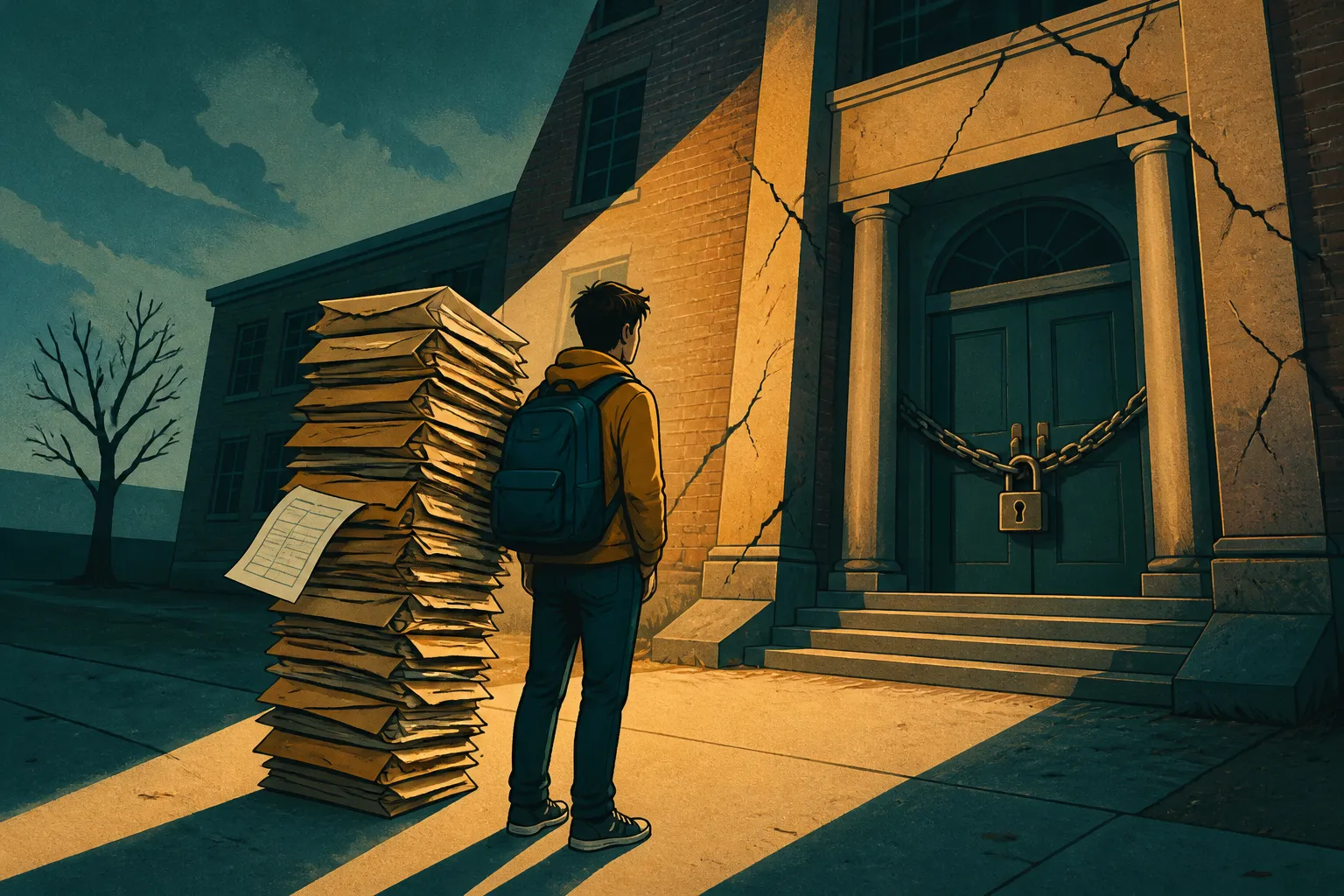
Short verdict: if your school shut down while you were enrolled, federal loans can be wiped out. Private loans, tuition paid in cash and your time are another story. The brochure never mentioned that split. Here is how it works, in order of what you should check first.
What a closed school discharge actually does
A closed school discharge can cancel your federal Direct Loans if you did not finish because the school closed while you were enrolled. It also covers you if you withdrew shortly before the closure, or if your campus closed while the rest of the school stayed open. If it is granted, the Department of Education cancels the loans you took out for that school, refunds payments you made on them, and removes the negative credit history tied to them. Collection costs and accrued charges go too. See the borrower assistance overview and the regulation text.
The closure date is not whatever date the school's sign came down. The rule uses the earlier of two dates: when the school stopped teaching the programs most students were in, or a date reflecting when it stopped instruction for everyone. Your withdrawal timing is measured against that. Gather your enrollment dates and any closure notices before you call your servicer.
The teach-out trap
A closing school is supposed to offer a teach-out plan. That means you finish at the closing school, or at a nearby school or campus under an arrangement. Sounds helpful. It can also cost you the discharge. Finish through a teach-out, or transfer credits into a comparable program, and you are generally not eligible.
One consumer source suggests taking the discharge first and later transferring credits to a school outside the teach-out agreement. Read that carefully. Another source warns that discharged loans may have to be repaid if you later move into a similar program. So the decision is real, and it comes early. Ask the school and your servicer two questions in writing: would finishing the teach-out end my eligibility, and would my planned transfer do the same?
Taxes, private loans and the sale loophole
A discharge can produce a tax bill. Discharged amounts may count as income in the year the discharge happens. If you cannot pay, you can petition the IRS to reduce it and ask the Office of the Taxpayer Advocate for help. Talk to a licensed tax professional before the discharge is final, not after the letter arrives.
Private student loans do not follow the federal process. They generally stay repayable after a school closes, though some states may have assistance programs. If you hold both kinds, sort them into two piles and treat each on its own rules. Also confirm what happened to the school. A sale is not a closure, and a sold school may leave you ineligible even if your program vanished.
If the school misled you instead
Borrower defense to repayment is the separate route for misrepresentation. Borrower information lives at StudentAid.gov/borrower-defense. A Department notice for schools says the school-side system temporarily lost functionality and that schools need take no action until further guidance. Check the official site for current status before assuming anything is open or shut.
The sources I reviewed do not explain how to prove a school misled you, or the eligibility criteria. Do not guess. Save the ads, emails, enrollment agreements and anything a recruiter promised, then ask a licensed attorney or a legal aid group what counts.
Where to complain
The right office depends on the money involved, per the CFPB guidance.
- Federal aid and federal loans: the Department of Education's Feedback Center.
- GI Bill benefits: the VA's Feedback System.
- Military Tuition Assistance or MyCAA: the DoD's Postsecondary Education Complaint System.
- Private student loans and federal loan servicing: the Consumer Financial Protection Bureau.
- The school's accrediting agency or state approval agency, in addition to any of the above.
Keep a copy of every complaint and every reply. Paper is your leverage.
Collections, costs and what to ask
Once a loan is discharged, collecting on it is improper. The CFPB has scrutinized servicers that sent discharged loans back to collections, and it directed some to return payments. If a loan you believe was cancelled keeps getting billed, that is a red flag. Log the date, amount and the representative's name every time.
Then ask yourself the blunt questions:
- Did my school or campus close while I was enrolled, or did I withdraw shortly before?
- Is there a teach-out, and would finishing it kill my discharge?
- Would a credit transfer to a comparable program do the same?
- Are any of my loans private?
- Could the discharge hand me a tax bill I cannot cover?
On cost, the sources give no dollar figures for refunds, fees or typical losses, and no state-by-state ranges. Tuition, housing and books vary widely by school and state, so total what you paid from your own records and statements. Nothing here covers recovering cash tuition outside federal loan discharge, or state tuition recovery funds. Ask your state's regulator whether one exists. This is general information, not legal, financial or tax advice. For your own loans, consult your servicer, a licensed attorney or a tax professional in your state.
Please seek a professional. This article is general information, not financial, tax or insurance advice. Please seek a licensed financial, tax or insurance professional about your own situation.
Sources
- Closed School Discharge - Student Loan Borrowers Assistance
- 34 CFR § 685.214 - Closed school discharge. | Electronic Code of Federal Regulations (e-CFR) | US Law | LII / Legal Information Institute
- Borrower Defense to Repayment Functionality Temporarily Unavailable for Schools | Knowledge Center
- Student loans | Consumer Financial Protection Bureau
- What happens to your student loans if your school is shut down | Consumer Financial Protection Bureau
- Where can I file a financial aid or student loan complaint? | Consumer Financial Protection Bureau
- CFPB Heightens Scrutiny of Unlawful Collection of Payments on Discharged Student Loans | Consumer Financial Protection Bureau
Still have a question?
Related guides
-

How to Compare Training Vendors Without Buying the Best Slide Deck
A plain method for small-business buyers to define the need, weight a scoring rubric, and pilot a program before signing a contract. By Imogen Tarrant
-

How to Check a Nursing or Allied Health Program Before You Pay
Accreditation, exam results, and clinical placements are the three claims a program should prove, and you can verify each one yourself before you commit money.By Dolores Kinnane
-

Ask for the Math Before You Trust a School's Placement Rate
A placement percentage means nothing until the school shows how it was counted, and a federal results site gives you a way to check.By Dolores Kinnane