How to Choose a Truck Repair Shop That Keeps Your Fleet Inspected, Documented and Legal
A short set of federal rules, a few documentation checks and the right questions can help a small fleet pick a shop that prevents violations rather than just fixing breakdowns.
 By Neil Ostrander ·

Who fixes your trucks matters as much as who drives them. If you run a small fleet, say three to fifteen vehicles, one missed brake adjustment can park a truck at the roadside and put a mark on your safety record. So how do you pick a shop that keeps you inspected, documented and legal? Start with the rules, then work through a short set of questions.
This guide is general information only. It is not legal, regulatory or financial advice. For your own fleet, check the current federal text and talk with a licensed professional.
Start with what federal rules require of your fleet
Federal Motor Carrier Safety Regulations Part 396 (49 CFR) covers inspection, repair and maintenance of commercial motor vehicles. In plain terms, it asks carriers and owner-operators to do four things:
- Inspect and maintain vehicles on a systematic schedule.
- Keep records of inspections and repairs.
- Complete annual inspections.
- Fix defects before the vehicle is operated again.
A shop's work has to fit inside that system, so you need to know whether it applies to you first. Part 396 covers commercial motor vehicles in interstate commerce. A vehicle generally counts if its gross vehicle weight rating, combined rating or actual weight is 10,001 pounds or more, whichever is greater. It also counts if it carries nine or more people including the driver for pay, sixteen or more without pay, or placarded hazardous materials. Interstate commerce includes trips that cross a state line, plus the in-state legs of a trip that starts or ends in another state.
Some small passenger van fleets fall outside the federal rule. State requirements, broker contracts or local permits may still set inspection standards for them. Sort out which rules apply to each vehicle before you compare shops, because that answer decides what records a shop must be able to produce.
Know where violations usually come from
Roadside inspections tend to find the same things: brake adjustment problems, tire tread depth violations, lights that do not work and missing annual inspection paperwork. These matter because a maintenance failure can bring an immediate out-of-service order. It can also hurt your CSA Vehicle Maintenance score, which shapes how inspectors see your fleet at future stops.
Most of these violations trace back to missing routines and paperwork, not rare mechanical breakdowns. A fleet can employ decent mechanics and still fail if nobody schedules and records daily and annual inspections. So when you evaluate a shop, ask yourself a simple question. Does it only fix what is broken today, or does it help you keep a structure that prevents the next write-up?
Check documentation and record-keeping ability
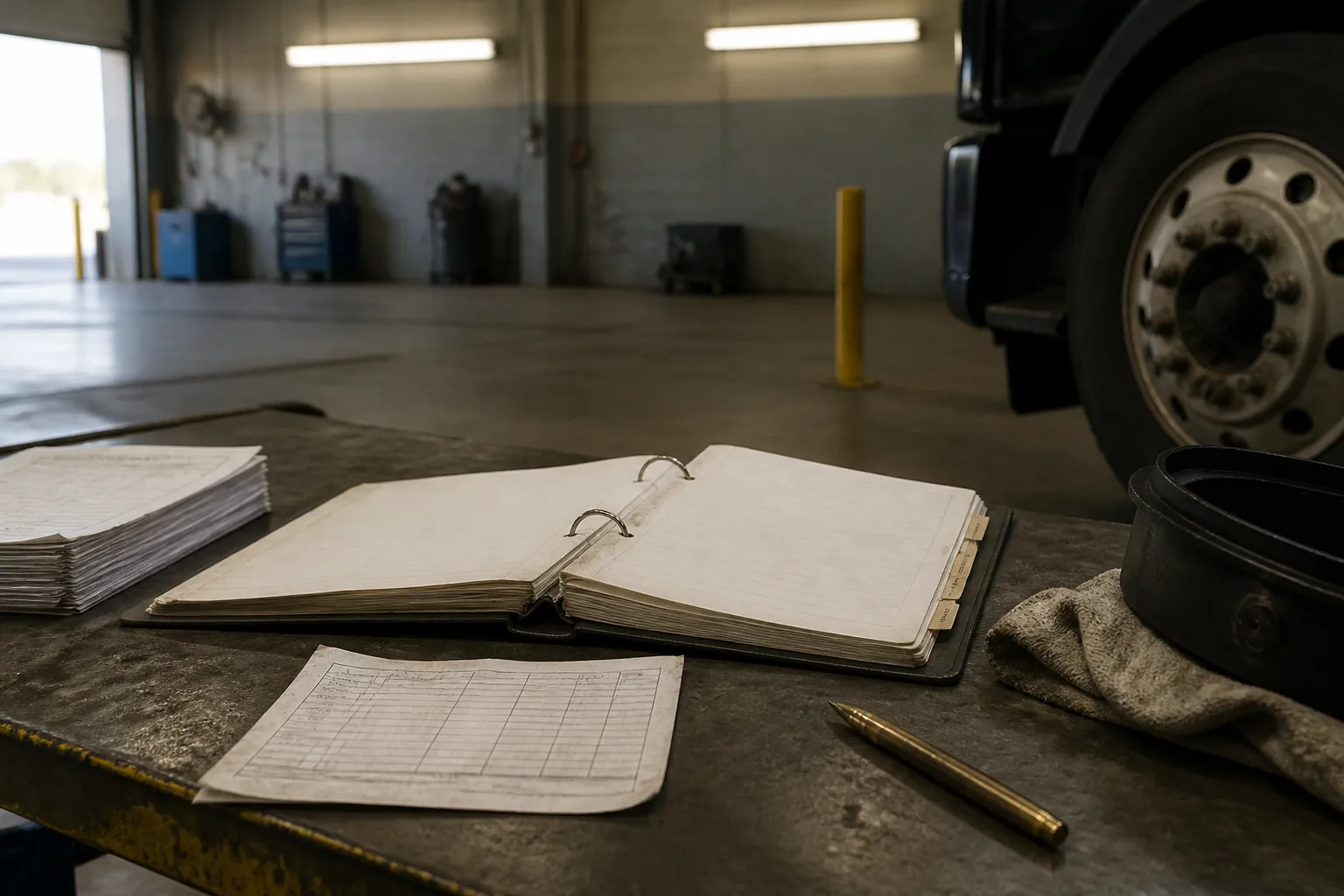
Paperwork is not a side issue. Under the federal penalty schedule in 49 CFR Part 386, Appendix B, a missing or incomplete required record can cost up to $1,584 per day, capped at $15,846. Federal penalties can reach $19,246 per violation. Those are federal figures, and state penalties may differ.
Ask the shop how it records inspection and repair results, how long it keeps them, and whether it can hand you copies that support your maintenance file. A good answer names the paperwork that comes with every job:
- An itemized repair order.
- A note of what was inspected.
- A note of what was fixed.
- The name of the person who signed off.
If your drivers use electronic Driver Vehicle Inspection Reports, ask whether the shop can work inside that workflow. An FMCSA final rule from March 2026 expressly allows electronic DVIRs when required data fields and signature requirements are met. Defects listed on a DVIR should be addressed before the truck goes back into service, so ask exactly how that handoff happens.
Verify technician qualifications
ASE, the National Institute for Automotive Service Excellence, offers medium-heavy truck tests covering Class 4 through Class 8 trucks and tractors. The T-series includes Gasoline Engines (T1), Diesel Engines (T2), Drive Train (T3), Brakes (T4) and Suspension and Steering (T5). Match those to the work you actually send out. A fleet of diesel box trucks cares most about T2 and T4.
Ask which technicians hold certifications in your key systems, and whether they are current. Certification does not guarantee a good job every time, but it gives you a documented baseline for comparing shops. Our sources do not walk through how to verify a certificate, so ask the shop for details and confirm them with the certifying organization before you rely on them.
Ask the questions that reveal how the shop works
Bring a short list to your first visit and write down the answers:
- How do you handle defects found on a DVIR before a vehicle returns to service?
- What happens when a repair cannot be finished the same day, and how will you tell me about an unsafe condition?
- Do you know the roadside inspection report rules of the states along my routes?
- What are your warranty terms, typical turnaround times and options for mobile repair?
On the third question, a 2026 FMCSA final rule effective July 22, 2026 says carriers return completed roadside inspection report forms only where the issuing state agency requires it. Your shop and your office staff should be working from the same understanding. The sources do not cover warranties, turnaround or mobile service, so those answers have to come from the shop itself. Ask for written estimates and compare them on the same scope of work, not on a single bottom-line number.
Watch for red flags and understand the cost picture
Be cautious if a shop cannot produce inspection and repair documentation, has gaps in annual inspection paperwork, or sends a truck out with known defects unresolved. Part 396 bars operating a vehicle with unresolved safety defects. Those gaps are exactly what inspectors and penalty schedules target.
On cost, the sources we reviewed did not give national figures for labor rates, parts or typical shop pricing. Prices vary widely by state, region, shop type and the size of the vehicle. Treat any single quote as one data point. Get several written estimates for the same work, and ask each shop to explain what is included.
For exact federal requirements, read the current text of 49 CFR Parts 396 and 386 in the eCFR or the Federal Register, and check your state's rules directly. A licensed transportation attorney or compliance professional can tell you how they apply to your fleet.
Please seek a professional. This article is general information, not legal advice. Please seek a licensed attorney in your state about your own situation.
Sources
- Federal Register :: Request Access
- DOT Vehicle Inspection and Maintenance Requirements - The Trucker Codex Blog
- Vehicle Inspection and Maintenance Files – Nationwide
- https://vertexaisearch.cloud.google.com/grounding-api-redirect/AUZIYQFnw9IAAlVT2-kph63m1AeaO3Pnh4AWy6lrvHc3Jtikttud0v3mwDddjRtfraf6XcKG374b6YN5pMexY9eCuYusnixHjomfGZ50_IOIvuiEInXdj4_jEVGxVDIg_MKhJ9iZXv0V8zGRge1alJSAmwetasUqWJeQ7KuIQI-felPGe7B1PfxbenuTcR2JuhRjozxDLU2lIw==
- The Motor Carrier Safety Planner
- FMCSA Part 396 Inspection Rules for NEMT | NEMTrepreneur
- Medium-Heavy Truck Certification Tests, T Series: T1-T8 | ASE
- Technology & Maintenance Council | American Trucking Associations
Still have a question?
Related guides
-

Fixed or Variable: How to Choose a Business Electricity Contract Without Getting Caught Out
A practical checklist for comparing quotes, avoiding the costly rollover to a deemed rate, and asking the right questions before you sign. By Renata Okafor
-

What Happens to Your Business Energy Bill When the Contract Ends
Letting a fixed-term energy contract lapse can quietly move your account to a much higher default rate, so knowing your end date, opt-out deadline and state rules matters.By Neil Ostrander
-

How to Read a Commercial Electric Bill, Section by Section
Supply, delivery and demand charges each answer a different question, and knowing which is which helps you spot errors and compare providers on total cost. By Gideon Aldaine