How to Choose a Water and Mold Remediation Contractor for Your Business
Verify certifications, confirm which standards will guide the work, and ask the right questions about containment, HVAC, and documentation before you sign anything.
 By Gideon Aldaine ·
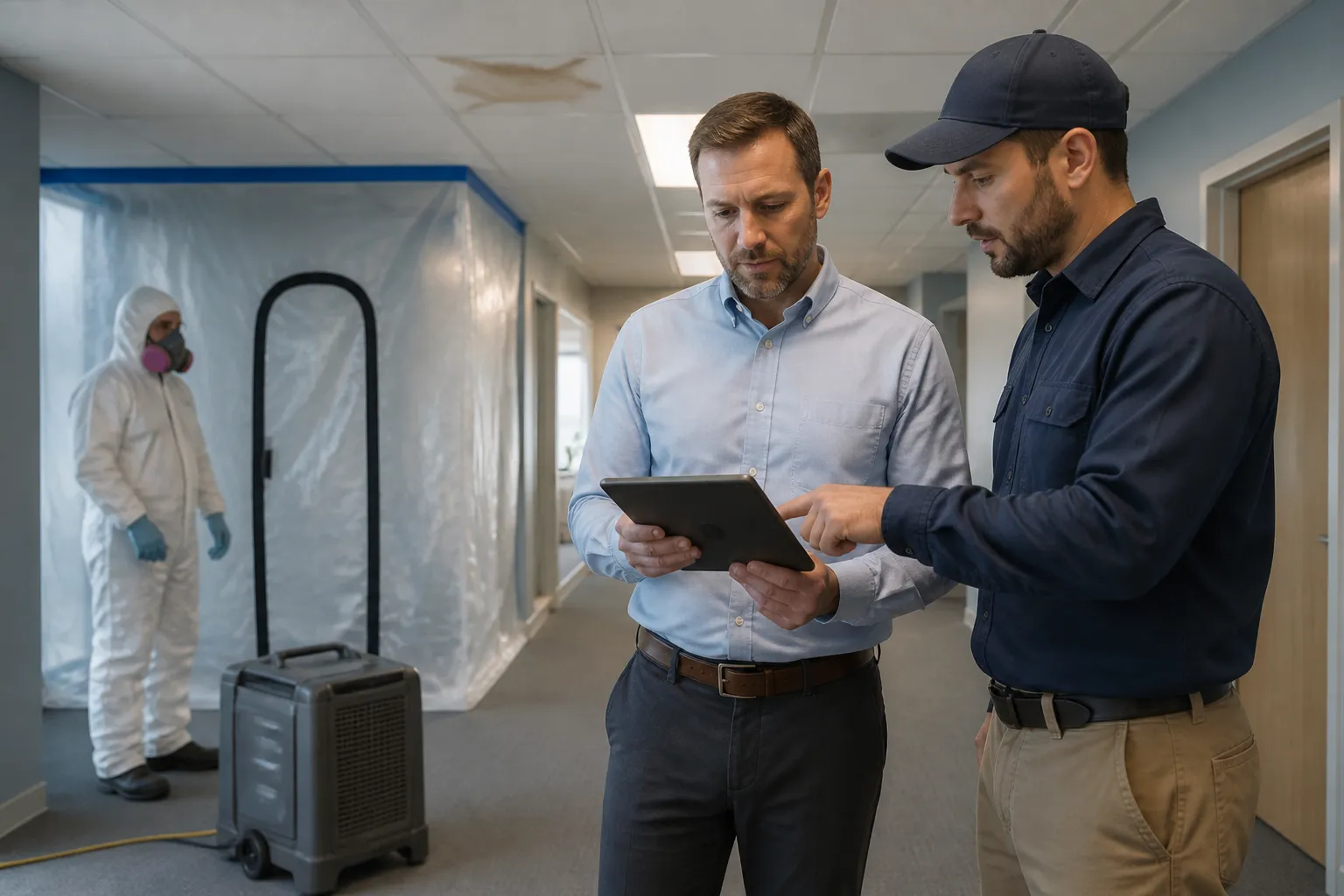
Your sales floor has a wet ceiling tile, a musty smell near the break room, and a manager asking who to call. Where do you start? Before you sign with anyone, it helps to have a short checklist in hand, because the choice affects safety, paperwork, and how fast you can reopen.

Why the choice matters for a business
A commercial job is not a bigger version of a home job. The affected area is often larger, the HVAC system may be shared across zones, and people may still be working nearby. You are deciding about safety and documentation as much as price, and about how soon the doors can open again.
Several sets of rules can overlap. Federal occupational health and environmental guidance applies to workers and occupants. State licensing and notification requirements may apply on top of that, especially for schools and other public buildings. Treat the hire as part of your risk management. Asking careful questions now is far easier than fixing a poorly contained job later. This is general information only, so check with a licensed professional about your own building and policy.
Check certifications and verify them yourself
The IICRC is a non-profit organization for the inspection, cleaning and restoration industries. Its Certified Firms employ one or more IICRC Certified Technicians. A good first step is to see whether the company is an IICRC Certified Firm.
Do not rely on a brochure or a sales call. The IICRC offers a Certified Firm verification page and a Global Locator, and you can also contact the IICRC with the company name. You can start at the IICRC certified firm verification page. If a firm cannot show certification, or does not turn up in those tools, ask more questions before going further.
- Ask which technicians will actually be on your site.
- Ask whether they hold IICRC certifications in the relevant specialties.
- Confirm both the firm and the individuals, since the two credentials are related but not identical.
Understand the standards the work should follow
IICRC Standards are internationally recognized, ANSI-accredited guidelines for best practices. Two matter most here: ANSI/IICRC S500 for professional water damage restoration and ANSI/IICRC S520 for professional mold remediation. You can browse the IICRC standards catalog.
For mold, a firm should be able to explain how its plan lines up with S520 and with the EPA's Mold Remediation in Schools and Commercial Buildings (EPA 402-K-01-001). You do not need to read every page. You should expect the contractor to name these documents and explain how they shape the plan. For water losses, ask which standard governs drying. A vague answer, or none, tells you something about the firm's process.
How mold and water remediation typically unfolds
Mold remediation generally runs in this order: assessment, containment, removal, cleaning, drying, and verification. In a large building each step gets harder, because the damage may cover several rooms or floors and the crew must work around occupied space.
Centralized HVAC and long runs of ductwork add another wrinkle. If air handling is not managed, contaminated air or debris can travel through the system. Ask how the firm will isolate zones and control the building's air during work. After storms, crews may also face electrical and structural hazards, so ask how they assess those before anyone enters and how they fit your own safety procedures.
Questions to ask before you sign
Work through these in order, and write down the answers.
- Do you employ IICRC Certified Technicians, and can I verify them on the IICRC tools?
- Which standard, S500 for water or S520 for mold, will guide this job?
- How will you contain the work area and protect occupants and workers during removal?
- What respiratory protection and OSHA-aligned mold training do your workers have, and can I see documentation?
- How will you handle our HVAC and ductwork across zones?
- What state licensing or notification rules apply to my facility, and how will you meet them?
Clear, specific answers suggest a defined method. A contractor who cannot discuss local rules may not know the environment it is working in.
Insurance, documentation, and contract terms
Restoration firms often work with insurance carriers on water mitigation claims, and documentation gaps can affect whether a claim is paid. Ask how the company records conditions, moisture readings, photographs, and scope of work, and how it shares that with you and your insurer. Your policy terms matter here, so talk to your agent or a licensed professional.
Read the contract closely. Look at the scope of work, how change orders are priced and approved, payment schedules, warranties, and how disputes are resolved. I could not find reliable US cost ranges in the research for this guide. Costs vary widely by state, building type, and the extent of damage, so get written estimates that describe the same scope and compare those, not a single headline number.
Red flags to watch for
Pause if a firm cannot show IICRC certification or cannot be found on the locator. Be wary of work that skips containment or respiratory safety, since that conflicts with OSHA's stated expectations. And be cautious of anyone who pushes you to start without an assessment or final verification. Remediation guidance describes those steps for a reason, and skipping them can leave contamination in place and your records thin.
Sources
- https://vertexaisearch.cloud.google.com/grounding-api-redirect/AUZIYQG1aKvvaB8eSqVyKBDMXIH2m7_ACooxVxs2GdYvAOcGIYuei5vrc7gpMGRpC2gPYuW-dOgPqCERo6pcUGqVZ2xa2UcUQSMZM3mmdDqFJHOEvBphQ201OBhMhrnkhQICxdtgCB-7a8UN_taEARQeIXi78jst1UWZMQQ_MVfkLDR2WpV2nA==
- IICRC Standards – IICRC
- Mold Resource Center | AIHA
- Mold Remediation in Schools and Public Buildings
- Tornado Recovery: Hazards | AIHA
- Step-by-Step Guide to OSHA Mold Remediation Certification and Compliance | ZOTA Professional Training
- Certified Firm Verification – IICRC
- Our Greatest Need
Still have a question?
Related guides
-

Fixed or Variable: How to Choose a Business Electricity Contract Without Getting Caught Out
A practical checklist for comparing quotes, avoiding the costly rollover to a deemed rate, and asking the right questions before you sign. By Renata Okafor
-

What Happens to Your Business Energy Bill When the Contract Ends
Letting a fixed-term energy contract lapse can quietly move your account to a much higher default rate, so knowing your end date, opt-out deadline and state rules matters. By Neil Ostrander
-

How to Read a Commercial Electric Bill, Section by Section
Supply, delivery and demand charges each answer a different question, and knowing which is which helps you spot errors and compare providers on total cost.By Gideon Aldaine