How to Vet a Commercial Refrigeration Provider Before You Sign
A practical checklist covering EPA certification, maintenance standards, and food temperature verification to help you compare providers on the same terms.
 By Renata Okafor ·
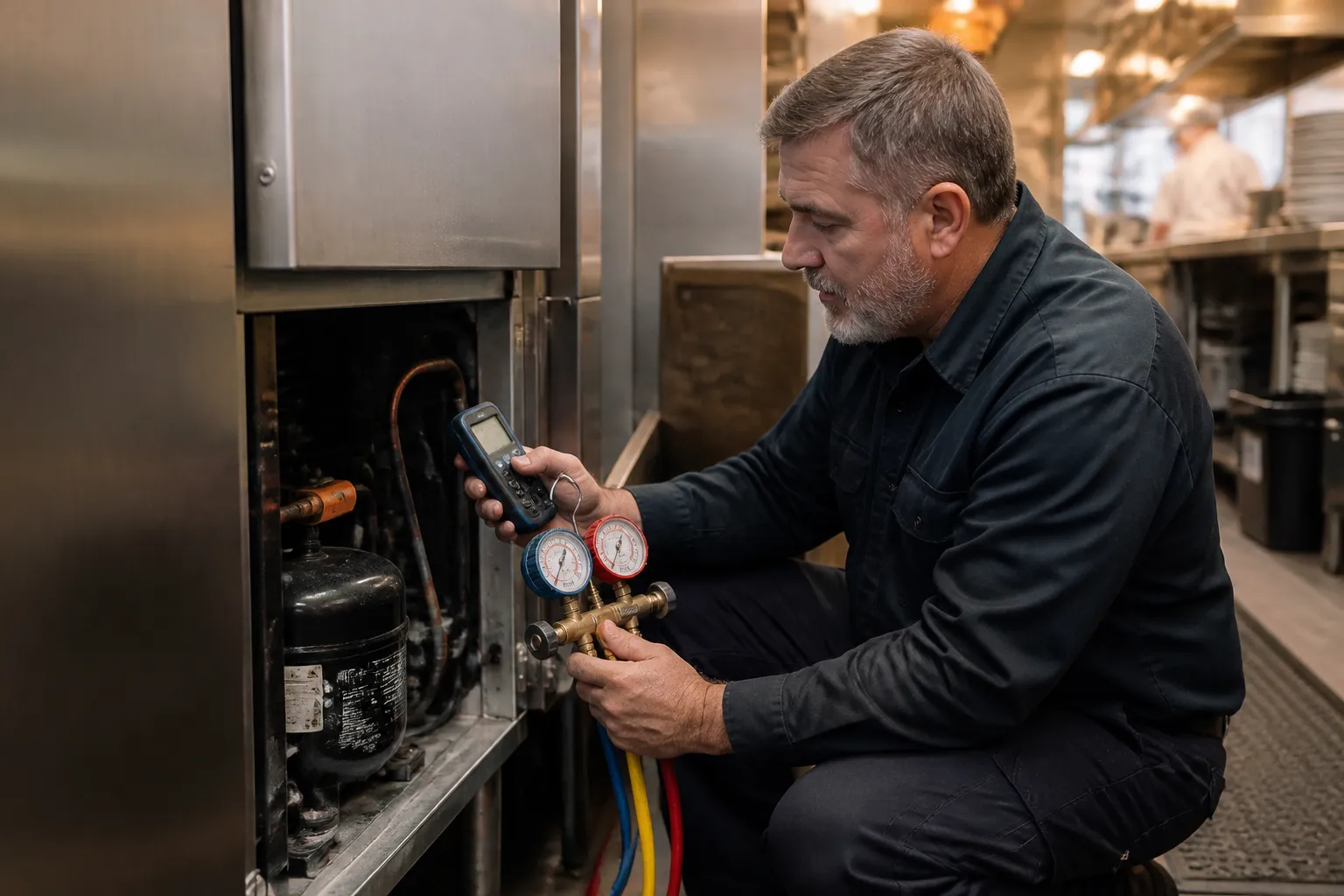
Is your walk-in cooler about to become the most expensive thing in your building? A failed compressor on a Friday night can cost you a week of inventory, and the provider you call first often decides how the weekend goes. This guide walks through the checks worth making before you sign anything: certifications, maintenance standards, temperature practices, and the questions that sort careful providers from careless ones. It is general information only, not legal, financial or personal advice, so confirm local rules with a licensed professional or your health department.
Start with EPA Section 608 certification
Under Section 608 of the Clean Air Act, technicians who maintain, service, repair or dispose of equipment that could release refrigerants must be certified by the EPA. Refrigeration work often falls under this rule, so it is the first check for any provider. Certification comes from passing an EPA-approved test, given by an EPA-approved certifying organization. Ask who issued each credential and whether it came from that kind of test.
There are four types, and the match matters:
- Type I: small appliances.
- Type II: high- or very high-pressure appliances, excluding small appliances and motor vehicle air conditioners.
- Type III: low-pressure appliances.
- Universal: all equipment.
Universal certification requires the core test to be taken as a proctored exam, since open-book core tests cannot count toward it. Section 608 certifications do not expire, so you can reasonably ask to see the credential itself rather than a renewal date. Apprentices may work without certification only if a certified technician closely and continually supervises them. Ask how that works on a real service call, not just on paper. You can read the rules on the EPA's Section 608 page.
Look for a recognized maintenance standard
Once credentials check out, ask what the maintenance visits actually include. ANSI/ACCA 14 QMref sets a minimum maintenance program for commercial refrigeration equipment in supermarkets, convenience stores, food service operations and warehouses running at saturated suction temperatures between -40°F and +40°F. ACCA describes its standards as consensus requirements for maintaining these systems, and you can find the document in ACCA's public files.
A provider that follows a recognized standard can explain what each visit covers and how it judges equipment condition. So ask these three things:
- Does your program follow ANSI/ACCA 14 QMref or another recognized standard?
- Can I have a written description of the scope?
- What happens when you find a problem outside that scope?
ACCA's wider quality standards cover design, installation, maintenance, repair and verification of indoor environment systems. They make useful background, though the refrigeration standard is the more direct reference. ASHRAE lists Standards 180 and 211 on its site, but the source gives no detail on their content. If a provider cites them, ask for a plain explanation of what they cover.
Understand the food temperature targets
A good provider knows what you are protecting. Under Section 3-501.16 of the 2022 FDA Food Code, cold-held time/temperature control for safety food must stay at 41°F (5°C) or below. The Food Code is a model, so confirm which edition and amendments your local health department enforces before you set targets. USDA guidance recommends keeping freezers at 0°F (-18°C).
Timing is the pressure point. Many state and local guides say food in the 41°F to 135°F danger zone should not total more than 4 hours before it is discarded, and certain bacteria can double about every 20 minutes under the right conditions. That is why response speed matters. Ask the provider who gets notified when a unit drifts above target, and how affected food is handled. Some products also follow separate receiving rules, so the plan should fit what you actually stock rather than apply one fix to everything.
Verify temperatures with a calibrated probe
Cabinet air temperature and food temperature can differ. A display reading alone does not prove the food inside is safe. A calibrated probe checks the food itself.
When you interview providers, ask how they verify food temperatures with a calibrated probe instead of trusting the display. Then ask about records:
- Who keeps the temperature logs?
- How often are readings taken?
- Can your staff and health inspectors see them during reviews?
A provider who shrugs at these questions is telling you something.
Use a checklist when comparing providers
Put the same questions to every candidate and write down the answers. Here is a short version you can carry into each call:
- Which Section 608 types do your technicians hold, and from which EPA-approved test or certifying organization?
- Do apprentices work under close, continuous supervision, and how is that documented?
- Does your maintenance program follow ANSI/ACCA 14 QMref or another recognized standard, and can I get the scope in writing?
- How do you verify food temperatures, and what is your plan when a unit rises unexpectedly?
Treat these as red flags: technicians who cannot show Section 608 certification for work involving adding or removing refrigerant, apprentices working without close supervision, and any reliance on the cabinet display alone to judge food temperature.
What these sources do not cover
Some of the most practical questions have no answer in the research behind this guide. It gives no US cost ranges for commercial refrigeration repair or maintenance contracts, and real prices vary by state, equipment and provider. Ask each company for a written quote and compare them on the same scope of work.
It also does not address contract terms, response times, warranties, insurance and liability, or equipment-specific maintenance schedules. Ask about each directly and get the answers in writing. Nor does it explain how to look up a specific technician's certification beyond the EPA-approved certifying organizations, or cover licensing beyond Section 608, such as state contractor licenses. Check those with your state and local authorities, and consider having an attorney review any service agreement before you sign.
Sources
- Section 608 Technician Certification Requirements | US EPA
- https://vertexaisearch.cloud.google.com/grounding-api-redirect/AUZIYQGn0wFhzsFWwKsh4rr1T6YisJ2Kn8mXSuiSpMAU0mYr87SisOLloK5iNr27vRHIgcbnadJIrdPWEgL03yx3EeMTvL8USbwFOvmfEi0EmJdDs3CqwAsYCatrY6rzAAcqUlNDGT_X1SjPIrIrvmJEhiHFmMWZvfSq6j69xVekcuvJcDWKyNn-qTA_reteixu-nl_keSpF_tlou85DyA==
- https://vertexaisearch.cloud.google.com/grounding-api-redirect/AUZIYQGrCunAdUogDOuui_nGb8wq7nUfKXzEVidRbdGpN0Rz1_J-LQD7nHOfD58e1L8GlDVfeUfmqdOLQOlz6BOPwKuyy0k8boPf4M5qdgS7p4Vtzn-M5BpBehlerjJ37krstHROUOLzpwfWCYo=
- Commercial Refrigerator Temperature Requirements – Empura.com
- The Temperature Danger Zone
- Quality Standards - ACCA
- Downloads - Public Files - ACCA
- Standards 180 and 211
Still have a question?
Related guides
-

Fixed or Variable: How to Choose a Business Electricity Contract Without Getting Caught Out
A practical checklist for comparing quotes, avoiding the costly rollover to a deemed rate, and asking the right questions before you sign.By Renata Okafor
-

What Happens to Your Business Energy Bill When the Contract Ends
Letting a fixed-term energy contract lapse can quietly move your account to a much higher default rate, so knowing your end date, opt-out deadline and state rules matters. By Neil Ostrander
-

How to Read a Commercial Electric Bill, Section by Section
Supply, delivery and demand charges each answer a different question, and knowing which is which helps you spot errors and compare providers on total cost. By Gideon Aldaine