What a Dust Collection System Really Costs, and What Drives the Price
Airflow, dust type and duct complexity shape the quote far more than floor space, so gather those three details before you ask any provider for a number.
 By Gideon Aldaine ·
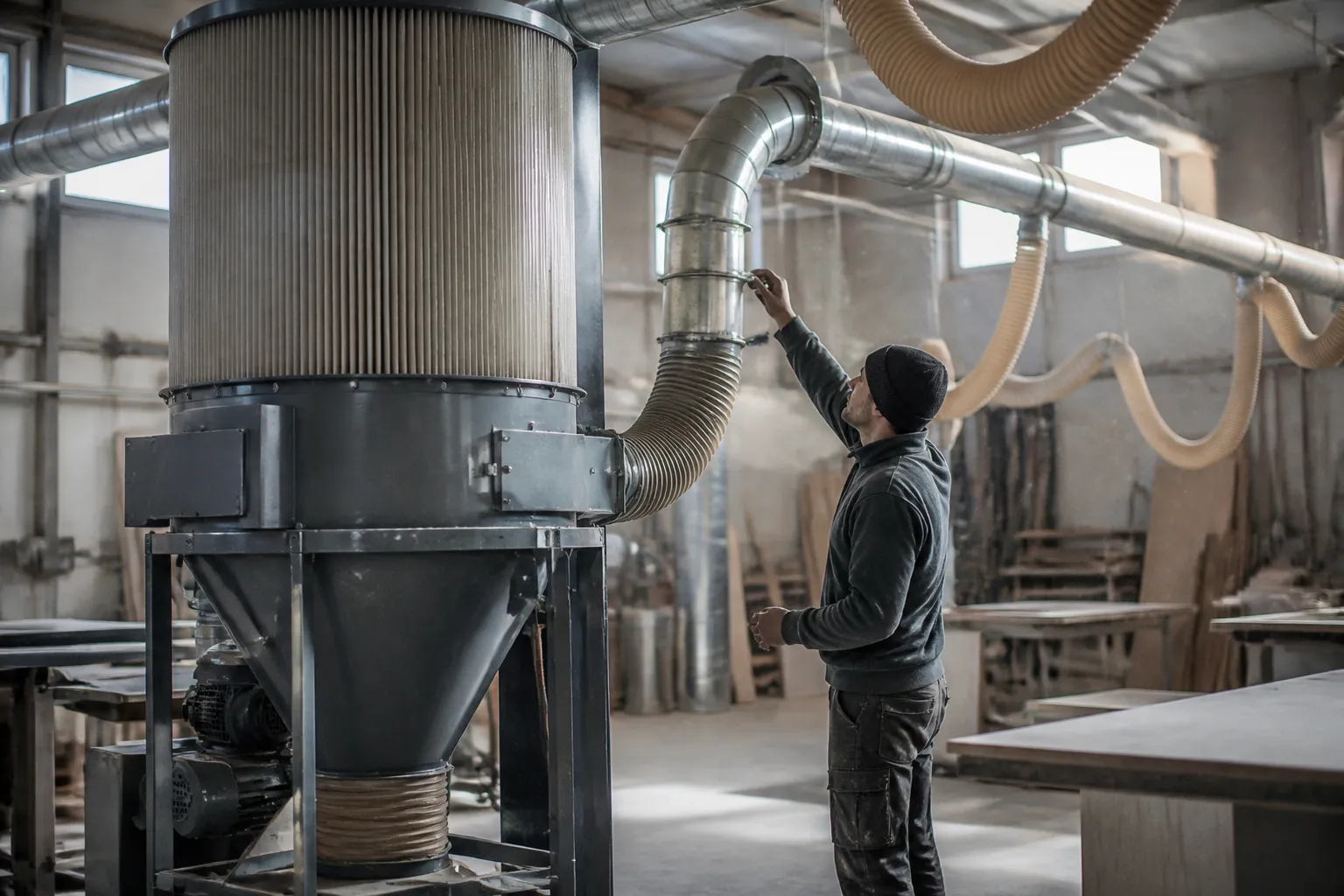
Is a dust collection system a $10,000 purchase or a $1,000,000 one? Both can be true, and the gap has little to do with how big your building is. This guide walks through the typical price tiers, what pushes a quote up or down, and the questions worth asking before you compare bids. It is general information only, not engineering, legal or financial advice, so run your own numbers past a licensed professional.
What drives the price
Many first-time buyers assume square footage sets the cost. Budgeting sources say it is a poor predictor. A large warehouse with one grinder may cost far less to equip than a small plant with a dozen dust-producing processes. Three things matter more, and you can check each one before you ask anyone for a number:
- Dust type. Fine, sticky or abrasive dust can call for different filter media and sturdier construction.
- Airflow. This is measured in cubic feet per minute (CFM). More pickup points and longer duct runs mean bigger fans and more filtration.
- Duct complexity. Long, branching runs cost more to design, build and install.
Then there is the big swing factor: combustible dust. If your material can burn or explode when suspended in air, NFPA and OSHA requirements may call for explosion venting, isolation or suppression. Those protections sit on top of the base system price.
Typical cost tiers by system size
The ranges below come from a vendor-published 2026 pricing guide, not from a government source. Treat them as rough starting points, not quotes. US prices also vary by state, local labor and material markets, and your specific situation.
- Portable extractor for one welder, grinder or CNC machine: roughly $8,000 to $25,000.
- Small central system with 4 to 8 pickup points and about 3,000 to 8,000 CFM: roughly $60,000 to $180,000.
- Mid-size manufacturing with 10 to 25 drops and 10,000 to 25,000 CFM: roughly $180,000 to $500,000.
- Full plant system with 25,000 to 60,000 CFM and NFPA-compliant protection: roughly $500,000 to $1.0 million.
- High-hazard combustible dust, such as some pharmaceutical, battery or fine metal work: roughly $1.0 million to $2.5 million or more.
Notice how the jump from one tier to the next tracks pickup points and airflow, not floor space. A portable unit needs almost no ductwork. A plant system is mostly ducts, fans and protection.
Dust hazard analysis and combustible dust compliance
If your facility generates combustible dust, there is a cost that is separate from the equipment. NFPA 660, effective January 1, 2026, requires a dust hazard analysis (DHA), which is a formal study of the hazards in your facility. One vendor source puts a complete DHA at about $9,000 to $85,000 or more, depending on facility size and process complexity.
Many providers price by the node. A node is a distinct unit, such as a process step, a dust collector, a silo or a building, and the common figure cited is $400 to $700 each. Node count is the main cost driver, so ask how many nodes are in scope before you agree to a price.
The same source says a custom-designed system that follows a DHA often runs $150,000 to $500,000 or more installed. Because the analysis can change what protection you need, it helps to understand its results before you lock in an equipment budget.
Running costs and total cost of ownership
The purchase price is only the start. Ongoing costs come mainly from electricity for the fans and compressed air used to clean the filters. A variable frequency drive can cut energy use by adjusting fan speed to real demand. Filter cartridges are consumables too, and how often you replace them depends on the dust, the media and how well the system is maintained.
So how do you compare a cheap system with a pricey one? Add up several years of electricity, compressed air and filters, then set that beside the upfront quote. A lower-priced unit with heavy energy use or frequent filter changes can end up costing more over its life.
How to compare quotes
Start by writing down your dust type, required CFM and number of pickup points. Give every provider the same sheet. Quotes built on the same assumptions are far easier to line up. Then ask each one:
- Do combustible dust rules apply to my operation, and does your quote include the protection they require?
- Is installation included? Labor can be a large share of the total.
- What is the expected energy use, including electricity and compressed air, and how does the design reduce it?
- What are the filter replacement intervals and cartridge costs?
- If I need a DHA, how many nodes are in scope and how is it priced?
Red flags and information gaps
Be wary of a quote based only on square footage. Be wary, too, of one that ignores running costs and filter replacement, since it understates what you will really spend.
Some questions the reviewed sources do not answer. They give no state-by-state price ranges, no separate costs for ductwork, fans or motors, and little on financing, insurance or maintenance labor. They also do not explain how to check an NFPA 660 analysis provider's qualifications. EPA's Control Cost Manual offers methodology for estimating air pollution control costs, including particulate matter, but it does not publish installed dust collection prices, and EPA is still updating it. For the gaps, ask providers directly and check with your state and local regulators and a licensed professional.
Sources
- Cost Reports and Guidance for Air Pollution Regulations | US EPA
- How to Evaluate Dust Collection Costs
- Dust collector total cost of ownership | Camfil
- Dust Collector Total Cost of Ownership
- What Does a Dust Collection System Cost in 2026? - Baghouse.com
- Dust Hazard Analysis Cost 2026: $9K–$85K by Facility Size
Still have a question?
Related guides
-

Fixed or Variable: How to Choose a Business Electricity Contract Without Getting Caught Out
A practical checklist for comparing quotes, avoiding the costly rollover to a deemed rate, and asking the right questions before you sign. By Renata Okafor
-

What Happens to Your Business Energy Bill When the Contract Ends
Letting a fixed-term energy contract lapse can quietly move your account to a much higher default rate, so knowing your end date, opt-out deadline and state rules matters. By Neil Ostrander
-

How to Read a Commercial Electric Bill, Section by Section
Supply, delivery and demand charges each answer a different question, and knowing which is which helps you spot errors and compare providers on total cost.By Gideon Aldaine