Who Owns Pest Control in a Food Plant? What to Check Before You Hire
Regulators hold your plant responsible for pests no matter who does the work, so know the requirements, credentials, and questions that separate a sound program from a risky one.
 By Gideon Aldaine ·

Who is actually responsible when a pest shows up in your plant, you or the company you pay to keep it out? The short answer is you. Before you compare proposals, it helps to know what regulators expect, which credentials mean something, and what to ask. This guide walks through it in order.
What regulators expect from your program
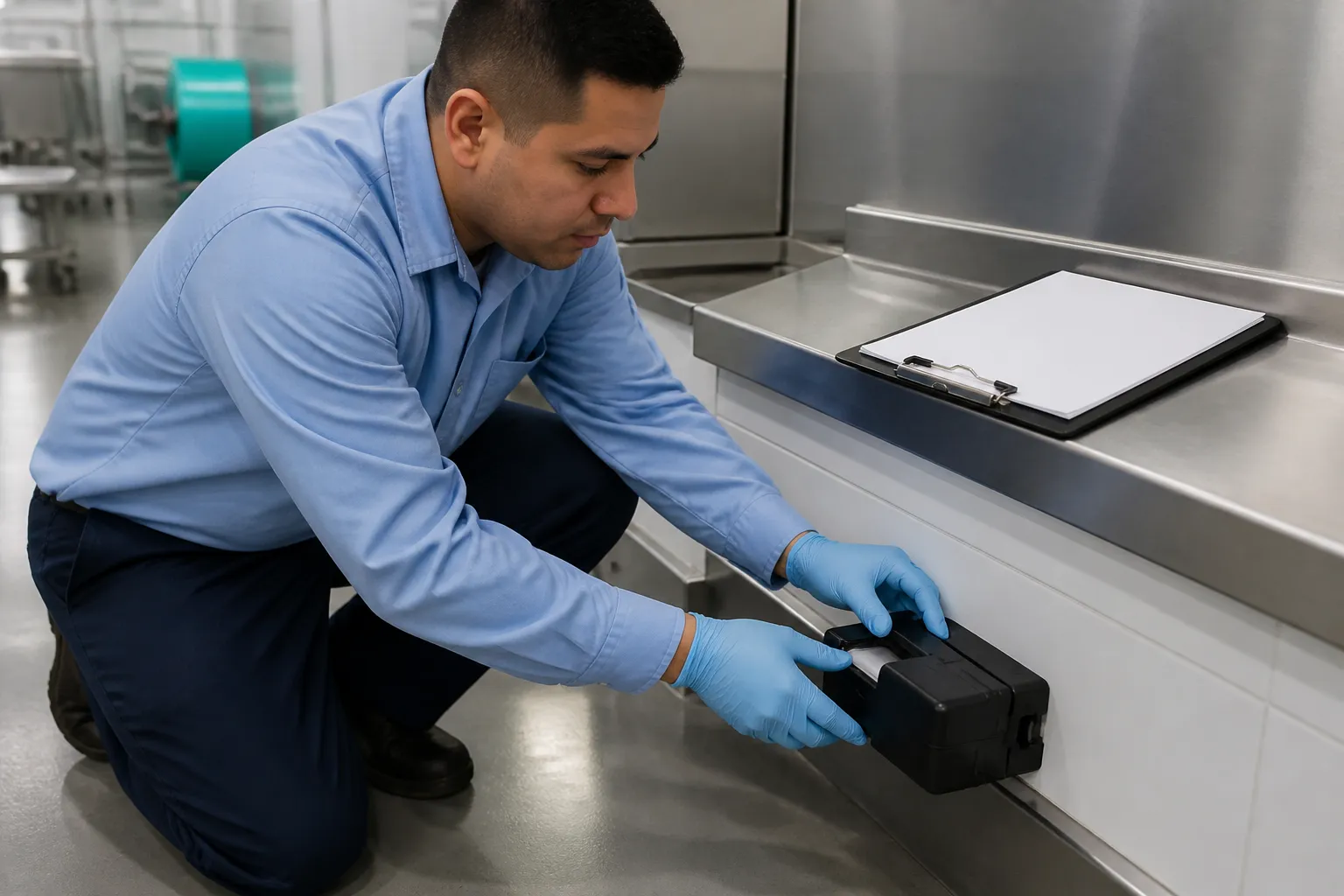
Under FDA's current good manufacturing practice rule, 21 CFR 117.35, pests must not be allowed in any area of a food plant. The plant must also take effective measures to exclude them and protect food from contamination. That duty belongs to the plant, so it stays with you even when a contractor does the work. A plant can outsource sanitation labor, but it cannot outsource accountability for its regulatory duties or its food safety system.
Your regulatory route matters too. FDA-regulated food facilities work under 21 CFR Part 117. USDA-regulated meat, poultry and egg plants work under 9 CFR Part 416 for sanitation. That shapes which records and verification steps a provider has to support.
A sound pest program rests on four pillars. A good provider can explain how it handles each one at your site, not just which products it applies:
- Exclude. Door sweeps, air curtains, sealed conduit penetrations and screened vents.
- Eliminate harborage. Clutter, standing water, overgrown vegetation near the building and storage gaps.
- Monitor. Traps, bait stations and scheduled inspections that leave a record.
- Document and correct. Findings written down, with fixes tracked to closure.
Pest control is usually treated as a prerequisite program that supports your food safety plan. It becomes a critical control point only if your hazard analysis says so. Ask your own food safety team how your plan classifies it before you compare bids. Also note that pesticide use in production areas must stay within what regulations permit and must never contaminate food.
Licensing and in-house versus contracted programs
Federal law requires states to license exterminators, but each state sets its own rules and applies them differently. A current license is a baseline. It says little about a company's business practices or how well its services work in a food setting.
You are not legally required to hire a licensed operator. An in-house program is allowed if it is equally rigorous and well documented. Still, most manufacturers contract the work, mainly to get the independent documentation that auditors and GFSI-benchmarked schemes expect. Either way, auditors judge effectiveness and records, not who holds the sprayer.
Credentials that carry weight
Third-party credentials tell you more than a company's own badge. QualityPro describes itself as the national credentialing authority for the pest management industry and says fewer than 3% of U.S. pest control companies hold its accreditation. Its Food Safety service certification requires each professional performing the service to have passed the Pest Management in Food Processing and Handling Facilities Exam. The key word is each. Confirm that the technicians assigned to your plant hold it, not just the company.
The Entomological Society of America runs two individual programs, Associate Certified Entomologist-Pest Control (ACE) and Board Certified Entomologist (BCE). They certify a person's entomological knowledge. ACE is aimed at people with training and field experience in structural pest management. They complement the food-facility exam and do not replace it.
Be careful with second-party certifications, meaning those from a company's internal program or from product makers and distributors. They can help with internal quality control. They are not objective proof of competence.
What a serious sanitation program looks like
Sanitation should not be a night crew that finishes tasks and goes home without checking results. A written contract sanitation program should spell out:
- Scope, zones and tools
- Chemicals, concentrations, dwell times, mechanical action and rinse requirements
- Sanitizer verification and inspection criteria
- ATP or other rapid verification, plus microbial testing where appropriate
- Corrective action, record review, escalation paths and training responsibilities
If a proposal skips these, ask why. The work should also be tied to your written programs and cover pre-operational discipline, food-contact surfaces and equipment condition for your type of plant. Records should do more than show a task was done. Look for monitoring data reviewed over time, concentration checks, verification results and clear pre-op release criteria.
Questions to ask before you choose
Work through these with each candidate, and write down the answers so you can compare them side by side:
- Does your documentation include trend analysis of monitoring data? SQF and BRCGS expect it.
- What do you do when activity rises, before it becomes a live infestation?
- Do you document chemical concentration checks and sanitizer verification?
- What verification do you use, and what are the pre-op release criteria?
- How do you train temporary workers and control tools?
- How do you support allergen changeover and customer audits?
- Which technicians hold the food-facility exam, and which hold ACE or BCE?
- Is your state license current and does it meet state requirements?
Watch for red flags. Pest activity trending up with no documented corrective action is one. Records that show tasks done but no results checked is another. So are undocumented concentration checks, vague release criteria, untrained temporary labor, and a provider whose only proof of quality is a state license or internal certificates.
What this guide does not cover
The research behind this guide had no reliable cost figures, so no price ranges appear here. Costs vary by state, plant size, service frequency and scope. Request written proposals from several providers and compare them line by line. The sources also did not address contract terms, insurance and liability, how to verify a license, or how to read a provider's audit history. Raise those with your food safety team, legal counsel and your state licensing agency before you sign. This is general information, not legal, financial or professional advice, so consult a licensed professional for your situation.
Sources
- Federal Register :: Request Access
- Pest Control Programs for Food Manufacturers | IONI
- USDA & FDA Contract Sanitation Requirements for Food Plants | FermiPro Clean
- Guidelines: Pest Management Standards for Food Processing & Handling Facilities
- Commercial Pest Control
- QualityPro Food Safety
- Pest Control Credentials
- Understanding Integrated Pest Management and How to Follow It
Still have a question?
Related guides
-

Fixed or Variable: How to Choose a Business Electricity Contract Without Getting Caught Out
A practical checklist for comparing quotes, avoiding the costly rollover to a deemed rate, and asking the right questions before you sign. By Renata Okafor
-

What Happens to Your Business Energy Bill When the Contract Ends
Letting a fixed-term energy contract lapse can quietly move your account to a much higher default rate, so knowing your end date, opt-out deadline and state rules matters. By Neil Ostrander
-

How to Read a Commercial Electric Bill, Section by Section
Supply, delivery and demand charges each answer a different question, and knowing which is which helps you spot errors and compare providers on total cost.By Gideon Aldaine