The $10,000 Gap: How Roof Coverage Terms Decide What You Pay
Actual cash value and replacement cost can leave a homeowner with very different bills for the same storm-damaged roof, so check the wording before renewal.
 By Marcus Delaney ·
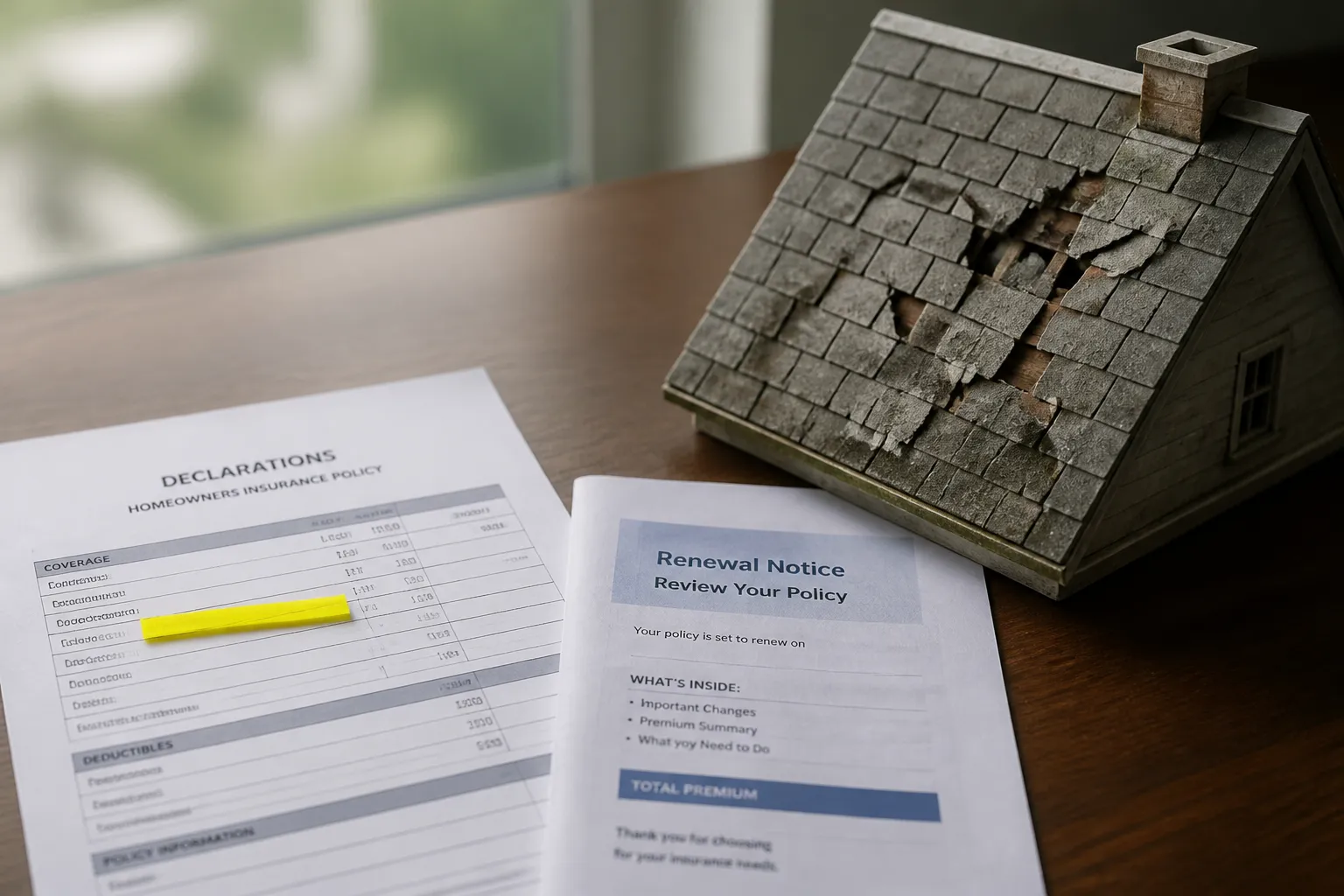
$11,000. That is what one consumer advocacy example says a homeowner could owe on a $20,000, 10-year-old roof under actual cash value coverage. Under replacement cost coverage, the same claim leaves about $1,000. The gap is depreciation, and it is easy to miss until a storm makes it your problem.
Why roof age matters to your homeowners policy
Insurers treat an older roof as a higher risk. Shingles wear down. Worn shingles fail more often in wind, hail and heavy rain. Roof age is one of the factors an insurer can weigh when it renews a policy, sets a premium, or changes how roof damage gets paid.
Roofs also drive losses. A Florida agency cites an industry estimate that roughly 70 to 90 percent of insured residential catastrophe losses nationally trace to roof-related damage. Treat that as one agency's estimate, not a settled statistic. It does explain why underwriters stare at roofs.
Age alone is not the whole story. Two identical roofs can be treated very differently. The difference is in the policy wording: how roof losses are paid, and whether a separate wind or hail deductible applies.
Actual cash value versus replacement cost value
Replacement cost value (RCV) pays to repair or replace the roof, minus your deductible. No subtraction for age. Actual cash value (ACV) starts from the same repair or replacement cost, then subtracts depreciation for the roof's age and type. Then it subtracts your deductible.
Here is the example again, with the math shown. The roof costs $20,000. It is 10 years old. Depreciation runs $1,000 per year, so $10,000 comes off. Add a $1,000 deductible. Under ACV you cover about $11,000. Under RCV you cover $1,000. The numbers are illustrative. Your policy sets the real ones, and the sources do not explain how insurers build their depreciation schedules.
Some insurers now offer ACV-only roof coverage on older roofs. Others use a roof payment schedule, which limits what is paid based on roof age. In one example, a schedule applied only to wind and hail losses. Fire losses were still paid at full replacement cost. So read which perils the schedule touches.
Some policies also add a special, higher deductible for wind or hail. That is a second way your share of a roof claim can grow.
Florida's 15-year roof rule and inspection option
Florida has specific rules. An insurer cannot deny or nonrenew a homeowners policy solely because the roof is less than 15 years old. The sources tie this to Florida Statute 627.7011. See the overview of the 15-year roof rule for one explanation.
If the roof is 15 years or older, you may pay for an inspection by an authorized inspector. If it shows at least 5 years of remaining useful life, the insurer cannot refuse to issue or renew the policy on that basis. The insurer also may not demand a roof replacement as a condition of coverage before the inspection is done. A 2024 bill, House Bill 1611, allows licensed roofing contractors to perform these inspections, per this Florida insurance blog.
The same source reports a 280 percent rise in Florida homeowner nonrenewals since 2018. Roof age is commonly cited. It also says Citizens dropped 90,000 policies in the Tampa Bay area, though not all for roof age.
These protections are Florida's. Other states differ, and many may have nothing similar. Details can change, so confirm the current rules and the list of authorized inspectors with the state regulator.
How to check your policy before a renewal
Start with the declarations page and any roof endorsement or schedule. A switch from RCV to ACV can show up only on the renewal notice. Put it next to last year's policy and compare line by line.
Then ask your insurer or agent plain questions:
- Does my policy pay roof claims at actual cash value or replacement cost?
- Is there a separate wind or hail deductible on the roof?
- Does a roof payment schedule apply, and what would it pay after a wind or hail loss?
- If my roof is 15 or older, can I submit a certified inspection showing at least 5 years of remaining life?
Ask for your share of a typical wind or hail claim in dollars, using a realistic roof cost for your area. Get quotes from more than one insurer before accepting reduced roof coverage. Compare them on the same terms, not on price alone. A licensed insurance professional can walk through the tradeoffs. This is general information, not advice for your situation.
Typical costs and what they depend on
The sources give no reliable state-by-state ranges for roof replacement or premiums. Costs vary by state, region, roof size, materials and local labor. Get quotes from licensed local roofers and rate information from insurers rather than leaning on a national average.
One source example uses an annual home premium of about $1,100. Treat it as an illustration. Premiums turn on location, home value, claims history, deductibles and roof condition.
For your own exposure, add three things: the standard deductible, any wind or hail deductible, and the depreciation an ACV policy would subtract. That sum is what you may owe on a roof claim. It is often far bigger than the deductible most people remember.
Red flags to watch for
- A renewal notice that changes roof coverage without saying, in dollars, what share of a claim you would now pay.
- A nonrenewal threat, or a warning that an aging roof will affect coverage, when the roof works fine. Ask for the reason in writing and whether an inspection could address it.
- In Florida, a demand to replace the roof before any inspection is completed. Ask which rule the insurer relies on. If the answer is vague, contact the state insurance regulator.
One more check. Federal Housing Finance Agency rules require borrowers with loans held by Fannie Mae or Freddie Mac to carry replacement cost coverage, according to United Policyholders. The group says this rule helps legitimize ACV-only roof coverage. The sources do not say how far the rule reaches across loan types. If an insurer proposes ACV-only roof coverage, ask whether it still meets your lender's requirements before you agree.
Please seek a professional. This article is general information, not financial, tax or insurance advice. Please seek a licensed financial, tax or insurance professional about your own situation.
Sources
- Florida 15-Year Roof Rule: Insurance Rules & Inspection Guidelines
- Florida Roof Age Rules and Insurance Nonrenewals: What Homeowners Should Know - The GreatFlorida Insurance Blog
- Roof insurance: ACV versus replacement cost - United Policyholders
- The Roof Over Your Head - United Policyholders
- Roof Age & Florida Home Insurance: Rules, Rights & Options
- Is Your Shingled Roof Too Old for Insurance? What Homeowners Need to Know—and Do - Chesapeake Bank
- Understanding Roof Age and Home Insurance: A Guide for Homeowners — Starr Mathews Insurance
- How your home can pay for emergency repairs | Bankrate
Still have a question?
Related guides
-

Replacement Cost Versus Actual Cash Value: What the Check Actually Covers
A dwelling limit and a payout rule can differ sharply, so the fine print decides how much of a loss you recover and when.By Marcus Delaney
-

What You Actually Pay: Reading Premiums, Deductibles and Out-of-Pocket Limits
A plan's monthly premium is only the first line of its cost, and adding up the full year shows which plan really costs less. By Hollis Brandt
-

What a Health Plan Really Costs Over a Year
The monthly premium is only the first line of the bill, so this guide shows how to add deductibles, coinsurance and out-of-pocket limits into one yearly estimate you can compare. By Teodor Valcourt