What to Do When Your Home Insurer Says Goodbye
Notice periods, mid-term cancellation limits and lender rules differ by state, so the first step is confirming whether you received a cancellation or a nonrenewal and when it takes effect.
 By Teodor Valcourt ·

Sixty days. That is the minimum warning Texas gives you before a home insurer can walk away at renewal. In California it is 75. In New York it is 45 to 60. The notice in your hands starts a clock, and the first job is to read it like a contract, because it is one.
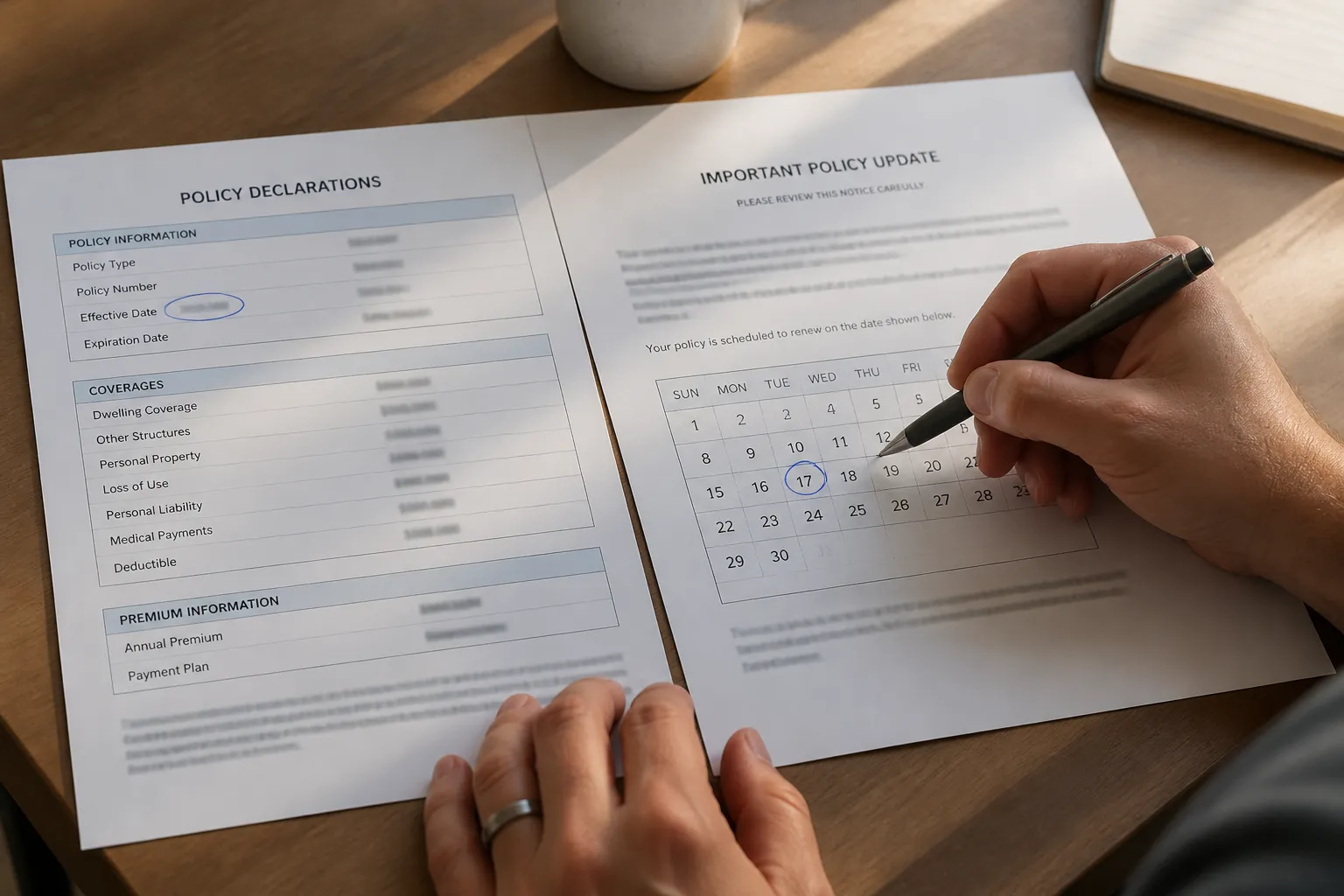
A nonrenewal keeps you covered until the expiration date. A cancellation ends coverage early. Check which one you got.
This is general information, not personal legal, insurance or financial advice. Rules differ by state and by situation. A licensed agent, attorney or your state insurance department can speak to your facts.
First, figure out what the notice actually means
A nonrenewal means the insurer will not offer a new term when the current one ends. Your coverage stays in force until the expiration date on your declarations page. A cancellation ends coverage before that date. The two carry different timelines, so confirm which one your notice says before you do anything else.
Read the effective date twice. In Texas, a mid-term cancellation takes effect on the 10th day after the notice is mailed. That is not much room. A nonrenewal gives you more time, but only if you use it.
Keep the notice, the envelope and any related letters or emails. They show when it was sent and what reason was given. If you later dispute the decision or file a complaint, those papers matter.
Know what your state requires the insurer to give you
Notice periods vary. Texas requires a home insurer that will not renew to mail written notice at least 60 days before expiration, or to renew the policy if you ask. Since January 1, 2026, Texas also requires a written statement naming the exact reason for a nonrenewal and where that information came from.
New York requires a nonrenewal notice to arrive at least 45 days and no more than 60 days before expiration. California requires a minimum of 75 days. If your notice arrived with less time than your state requires, raise it with your state insurance department.
California's insurance department has a page titled "Mandatory 1 Yr Moratorium on Non-Renewals." The text I could review did not explain the rule, so its length and conditions are unknown. If you live in California, read the department's page for the current terms.
Understand when an insurer can cancel mid-term
Mid-term cancellation is supposed to be hard. Texas limits it. Allowed grounds under Texas Insurance Code Section 551.104 include nonpayment of premium, a fraudulent claim, a Texas Department of Insurance finding that continuing the policy would break the law, and an increase in hazard within your control that would raise the premium.
There is a narrow exception for new Texas policies. In the first 60 days, a company can also cancel if it finds an undisclosed risk-increasing condition that was not the subject of a prior claim, or if it did not accept a required inspection report.
New York is stricter in one way and looser in another. During the first 60 days, an insurer may cancel for any reason, but the notice must state the specific reason. After that, a policy generally cannot be cancelled or nonrenewed for three years except for listed reasons. Those include:
- Nonpayment of premium.
- Fraud or material misrepresentation in getting the policy or in a claim.
- Willful or reckless acts that increase the hazard.
- Physical changes that make the property uninsurable under the insurer's uniformly applied standards.
- A Superintendent determination that continuing the policy would violate the Insurance Law.
After three years, the company may refuse to renew. For nonpayment in New York, if your payment reaches the company within 15 days of the mailing of the cancellation notice, the policy will not be cancelled. Claims history can also matter. Some carriers limit how many claims you can file before flagging you as higher risk, which can lead to nonrenewal.
Protect your mortgage while you shop
Your mortgage lender generally requires the property to be insured. If your coverage lapses, the lender may buy a policy and bill you. The Consumer Financial Protection Bureau says this lender-placed insurance can cost twice what you would normally pay, and it usually protects only the lender, not you. See the CFPB advisory for the federal rules on when a servicer may buy coverage. The text I reviewed was cut off before those details.
So do not let coverage lapse. Line up the new policy's start date with the day the old one ends. If a gap looks unavoidable, call your lender early and ask what options exist.
Shop for a replacement policy early
Start the day the notice arrives. California consumer guidance says you will likely need most or all of the notice period to find a replacement you can afford. Texas guidance says to use its 60 days both to challenge errors in the notice and to shop.
Expect to pay more, and possibly get less. The sources reviewed gave no typical dollar ranges, and premiums swing widely by state, home age, location and claims history. Compare limits, deductibles and exclusions, not just the premium line.
If standard carriers are passing on your property, the replacement may come from a non-admitted insurer. These companies often take risks that well-known admitted carriers have dropped. Non-admitted policies are generally not backed by the state guaranty fund. Ask what happens to your claim if the insurer fails.
In parts of California, homes in brush-heavy or forested areas hit by recent wildfires may be hard to insure. Ask an agent whether home improvements could help you qualify for renewal or a new policy.
Check the people you work with and your options for dispute
Check the license of any agent or broker before you hand over information or money. California's Department of Insurance offers a license status search, and most states have a similar lookup on the regulator's site.
Then ask plain questions:
- Is this a cancellation or a nonrenewal, and what is the effective date?
- What is the exact reason, and where did that information come from?
- Can I make changes to the home that would qualify me for renewal?
- If my lender requires coverage, what would the lender-placed option cost compared with a policy I buy myself?
Watch for red flags. No stated reason. A notice that came with less time than your state requires. A mid-term cancellation for a reason outside your state's list. A lender-placed policy you did not choose.
If you think the decision was wrong, contact your state insurance department and ask about its complaint process. The sources reviewed did not explain appeals, so check the regulator's website for steps and contact details. Read the fine print on every page. It is where most of these disputes are decided.
Please seek a professional. This article is general information, not financial, tax or insurance advice. Please seek a licensed financial, tax or insurance professional about your own situation.
Sources
- Consumer advisory: Take action when home insurance is cancelled or costs surge | Consumer Financial Protection Bureau
- Texas Home Insurance Nonrenewal: What to Do Next
- Homeowners Insurance: Cancellations and Nonrenewals | Department of Financial Services
- Mandatory 1 Yr Moratorium on Non-Renewals
- Dropped by your home Insurer? Where to go for help in California - United Policyholders
- https://vertexaisearch.cloud.google.com/grounding-api-redirect/AUZIYQHrFkHSfbwIBCA0zF1mbCxzE9Uvld5PJ7UC4OqLdMFTPgrk0nZbekWQVpE3Ay6GVaOOooOPjU-zCRaVjwmhhHblLnfbysylX-S50d-Km_luHINj4BR5gsr7GLKtooc2dMnTc3c73l5w9KZqD-wOaZfMYrdj5ndcpOHQxbM_l5z6nDazIS_b0A==
Still have a question?
Related guides
-

Replacement Cost Versus Actual Cash Value: What the Check Actually Covers
A dwelling limit and a payout rule can differ sharply, so the fine print decides how much of a loss you recover and when. By Marcus Delaney
-

What You Actually Pay: Reading Premiums, Deductibles and Out-of-Pocket Limits
A plan's monthly premium is only the first line of its cost, and adding up the full year shows which plan really costs less. By Hollis Brandt
-

What a Health Plan Really Costs Over a Year
The monthly premium is only the first line of the bill, so this guide shows how to add deductibles, coinsurance and out-of-pocket limits into one yearly estimate you can compare.By Teodor Valcourt