What Movers Charge and How to Compare Quotes Fairly
Local and long-distance moves follow different pricing logic, so knowing which one applies makes the numbers far easier to check.
 By Renata Okafor ·

What will a mover actually charge you, and why do two quotes for the same couch and the same boxes look nothing alike? The short answer is that local and long-distance moves are priced on different logic, and once you know which logic applies, the numbers get much easier to check. This guide walks through the ranges, the mechanics, and the questions worth asking. It is general information only, so confirm details with the movers you are considering and a licensed professional where your own situation calls for it.
A spread like $4,500, $7,200 and $11,500 for the same job is a reason to ask questions, not a reason to pick the middle number.
How local and long-distance moves are priced
Local moves, generally within about 50 miles, are usually billed by the hour. Crew size and time on the job drive the total, so a move that runs long costs more. In 2026 U.S. averages, two movers and a truck run about $110 to $170 per hour. Three movers run $150 to $240, and four movers run $200 to $320.
Long-distance interstate moves work differently. Under FMCSA rules, the charge is based on the actual weight of your shipment and the mileage between ZIP codes, plus any specialty add-on services. In-state moves that cover a longer distance tend to land between the two approaches, at roughly $1,200 to $4,500 or more, depending on the state and carrier.
Typical cost ranges
For long-distance moves, 2026 U.S. averages run about $2,500 to $7,000 for small moves, $5,000 to $14,000 for mid-size households, and $8,000 to $20,000 or more for large homes or complex routes. By home size, the ranges look like this:
- Studio: $1,500 to $3,200
- One bedroom: $2,000 to $4,500
- Two bedrooms: $3,500 to $7,500
- Three to four bedrooms: $5,500 to $12,000
Cross-country moves of 2,000 miles or more cost more. A studio may run $2,500 to $4,500, a one bedroom $3,500 to $6,500, a two bedroom $5,500 to $10,500, and a three- to four-bedroom home $8,500 to $18,000 or more. These are U.S. averages in dollars. Your actual price will vary by state, route, access at each address, moving dates and service level, so treat them as a rough guide and not a quote.
Prices also climbed through 2024 as labor, insurance and fuel costs rose, and rates are expected to stay elevated in 2026. One more caution: these figures come from a trade publication and a moving company blog, not official government cost data.
What drives the final price and how tariffs work
Licensed interstate carriers must publish a tariff, which is an official rate book of the charges a mover can apply. Rates are calculated per pound and per mile, with standard extra fees. An interstate estimate is built from that book and can cover transportation, packing, valuation, storage and auxiliary fees.
Several things move the total up or down:
- Weight or cubic footage of the shipment
- Miles traveled
- How flexible your dates are
- How hard the destination is to reach, such as tight access or long carries
- Heavy items, and whether packing is included
Typical long-distance inclusions are linehaul, loading and unloading, and basic valuation, which is the minimum liability coverage. Fuller insurance options and packing or storage costs are not priced in the sources used here, so ask about them directly.
Discounts apply against the tariff, which makes the percentage misleading. A 60 percent discount on a high base can cost more than 45 percent off a lower base. Compare final dollar totals.
How to compare estimates and choose a mover
Work through it in order:
- Contact at least three companies and ask for estimates based on an in-person or virtual survey, not a phone call alone. The American Trucking Associations advises this.
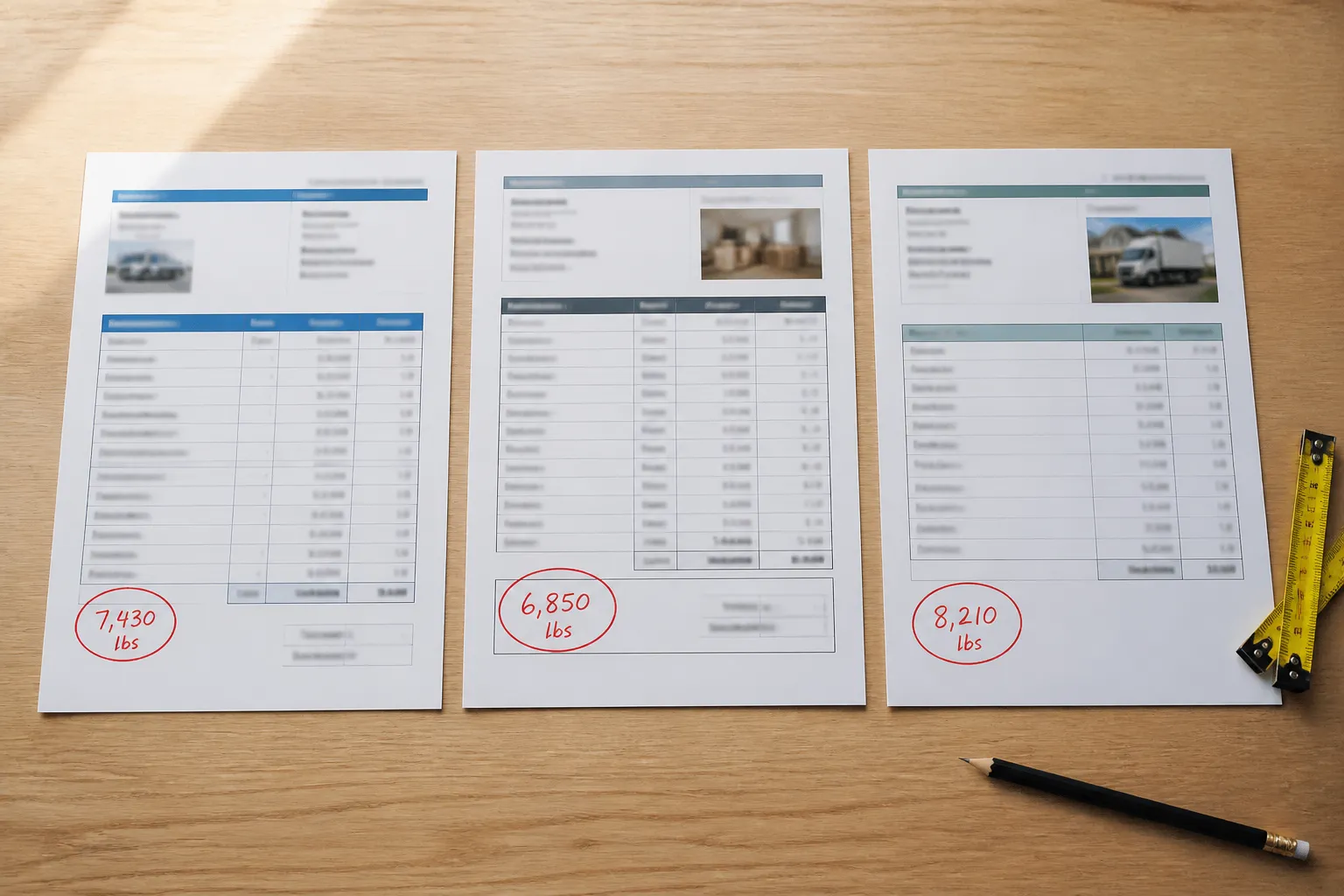
- Ask each mover to confirm the estimated shipment weight or volume in writing. If one quote assumes a lighter load, the numbers cannot be compared fairly.
- Request a copy of the official tariff.
- Ask what extra fees or add-on services could apply beyond the base rate.
- Check each total against the national ranges above to spot outliers, high or low.
Then compare the final price, not the discount percentage, and ask any mover with an outlier quote to explain the difference.
Red flags and what to watch for
Some warning signs are worth taking seriously:
- A mover that will not give you its official tariff.
- An estimate given by phone with no survey.
- An ultra-low, too-good-to-be-true number. The ATA links these to scams and costly mistakes.
- Pressure to move quickly and cheaply, which the ATA says can lead to fraud.
- A big advertised discount with no final total attached.
Before you sign, check the mover's registration and safety record. The FMCSA Protect Your Move portal is one place to start, though the sources here do not describe the full verification steps. They also do not cover what to do if the final bill exceeds the estimate, so ask the mover how that is handled before the truck is loaded.
For background, see the American Trucking Associations consumer guidance and the explainer on long-distance pricing and tariffs.
Sources
- The Real Cost of Long Distance Moving Companies (and Why It's So Confusing)
- ATA Moving and Storage Conference Gears Up for National Moving Month | American Trucking Associations
- Moving & Storage Membership | American Trucking Associations
- How Much Do Movers Cost? (Averages by State & City) - Freightwaves Checkpoint
Still have a question?
Related guides
-

The Driveway Quote: How Moving Estimates Get Rewritten After the Truck Is Loaded
Binding, non-binding, and not-to-exceed estimates carry different risks, and knowing which one you're holding is the best defense against a price jump at delivery. By Gideon Aldaine
-

How to Tell Whether a Haircut and Color Quote Is Fair
National 2026 ranges, the factors that move prices, and the questions that make two salon quotes comparable.By Renata Okafor
-

How to Check a Stylist's License Before You Book
A few minutes on the state lookup can confirm whether your stylist is authorized to work, and it tells you what to ask before you sit in the chair. By Neil Ostrander