Choosing Senior Living for a Parent Who Can't Hear or See Well
A practical guide to the questions worth asking on a tour, from assistive listening systems to daily support for low vision, and where to find answers the sources here cannot give.
 By Priya Ranganathan ·
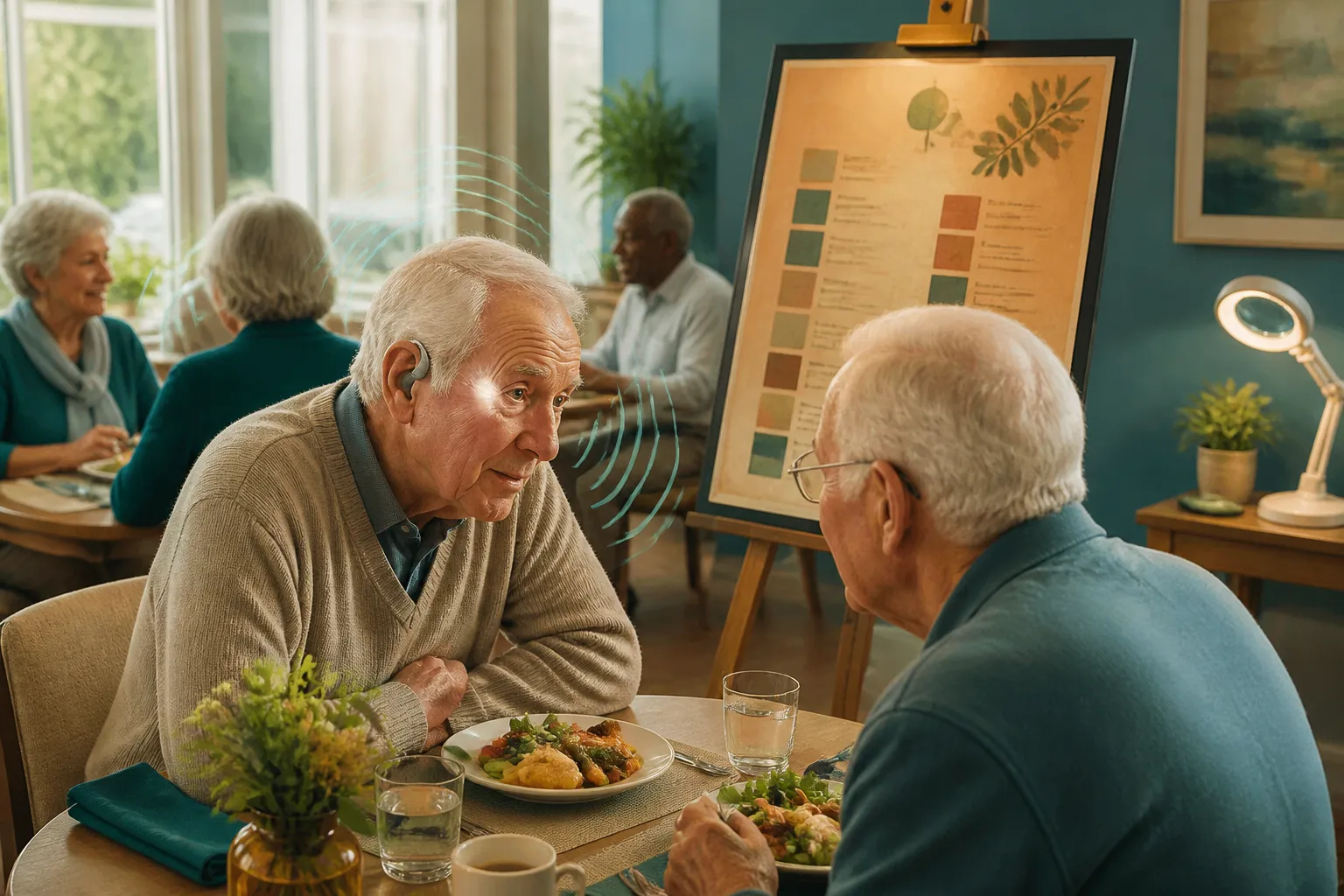
Picture a dining room at lunchtime. Forks clink, a television murmurs, someone at the next table laughs. For a parent with hearing loss, that room can feel like a wall of noise. For a parent with low vision, the menu board across the room may as well be blank. Choosing senior living for either of them means looking past the brochure and asking how an ordinary day would actually go.
Start with what the sources can and cannot answer
I want to be plain about the limits here. The material I drew on explains assistive listening technology and what common vision loss terms mean. It does not speak to senior living communities, nursing homes, or assisted living in particular. So this guide cannot hand you facility-level rules, and I would be wary of any article that claims it can without showing its work.
Two Medicare nursing home checklists were also part of the research, but their files were unreadable in the material I had. I will not guess at what they say. You can look at them yourself on medicare.gov, and they may be a useful starting point for your tour notes.
Costs are another gap. No price ranges for senior living, hearing devices, or vision aids appeared in the sources, and any figure would vary by state and by a family's situation. When you call communities, ask for fee schedules in writing, and consider talking with a licensed financial or elder care professional before you commit. This is general information, not medical, legal or financial advice.
Understand the hearing technology a parent may need
Assistive listening systems send sound from a public address system straight to a hearing aid, a cochlear implant, or a separate receiver. That can help a person follow speech in a noisy room or from far away, which is exactly the trouble in many dining rooms and activity spaces. Hearing Loss Association of America notes that the Americans with Disabilities Act requires these systems where a public address system is used, and that a person may ask for the type they prefer.
There is no single best option. Hearing assistive technology is a broad category, and the right fit depends on the kind of hearing loss and the place where communication matters most. A chapel, a dining room, and a clinic visit may each call for something different.
Common system types include:
- Hearing loop systems, which use a looped wire and amplifier that send sound to a telecoil or receiver.
- FM systems and infrared systems.
- Wi-Fi audio systems.
- Auracast, a newer wireless broadcast based on Bluetooth LE Audio.
Some need hard wiring, and all need a receiver of some kind. For one-on-one talks, a personal amplifier or a smartphone app may do more good than anything installed in the building. Apps can boost sound, turn speech into text, or caption calls.
Know how the ADA applies and where to direct questions
Title III of the ADA covers private businesses open to the public. The examples listed include healthcare offices and pharmacies. The U.S. Department of Justice writes the Title III regulations and is the main federal enforcer, as this overview of the ADA and assistive listening explains.
What the sources do not say is whether Title III reaches residential senior living, or how it treats resident rooms compared with common areas. Please do not assume either way. A qualified attorney or the Department of Justice can answer that for your parent's situation.
One red flag is still worth carrying with you. If a community uses a public address system but offers no assistive listening, it may not meet ADA requirements for that space. That is an inference, not a finding, and any real enforcement question belongs with the Department of Justice.
Ask about vision loss and daily living support
Vision loss has two labels that get mixed up. Legal blindness, used for U.S. benefit eligibility, means central visual acuity of 20/200 or less in the better eye with best correction, or a visual field of 20 degrees or less. Low vision means measurable sight, with trouble on visual tasks even with corrective lenses. According to the American Foundation for the Blind, many people with either label still have usable vision.
That matters on a tour. Your parent may not need everything a brochure for "blind residents" would promise, but may need help with reading, getting around safely, caring for themselves, cooking, and recreation. Those are the daily activities vision loss can touch, so use them as headings in your notes.
The sources do not explain how to judge staff training, emergency alert systems for residents with hearing or vision loss, or referrals to low vision rehabilitation or audiology. Treat each of those as an open question and ask it out loud.
Build a question list for tours and phone calls
Bring a short list and write down the answers, with the name of the person who gave them. A few good ones:
- Do you offer assistive listening on request, and which system types do you use?
- Do you have Auracast or hearing loop systems anywhere in the building?
- Can you support audio description for residents with vision loss? Auracast can carry extra audio streams for that purpose.
- How do you help residents outside common areas, such as in-room communication and daily living supports?
- Which state agency licenses the community, and how does a family file a complaint?
The last question deserves a check of its own. The sources do not cover state licensing, so look up your state's regulator directly rather than relying on the community's answer alone.
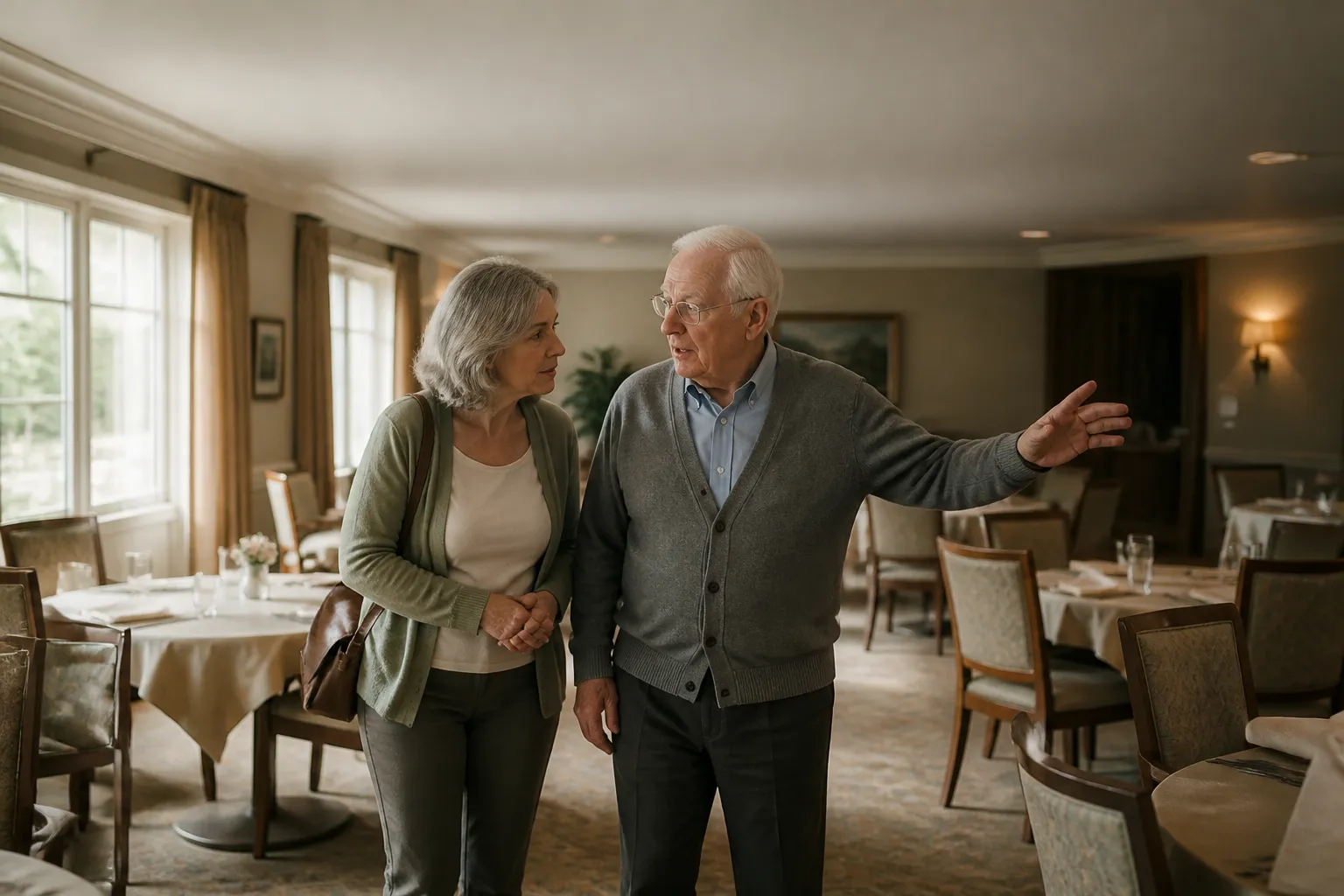
Visit at a busy hour if you can, and sit in the room for a while. Notice whether your parent leans in, squints, or goes quiet. Then ask a licensed professional, such as an audiologist, eye care provider, or elder law attorney, to help with the decisions that are theirs to make.
Please seek a professional. This article is general information, not medical advice. Please seek a doctor or other qualified health professional about your own situation. In an emergency, call 911 or your local emergency number.
Sources
- https://vertexaisearch.cloud.google.com/grounding-api-redirect/AUZIYQG_OnDqG_1ZK6q6WeweKMD4C0Do0zREWp8Dj1G8gggFvse-p05pivBBXqt12eYP2loeYHqTBPuBF7AxpWCEG-LE_qbKy5pJzkhAcMjFYy9KMa2XpUQsB_FrAWkgS2rwqzY_1xalUXi5Gm-4jZM-GKz-iAeJtw-4KgVexO3HLJRwVsMrEzEwDNphJOqy6qw9qkP96bjxgxjh
- https://vertexaisearch.cloud.google.com/grounding-api-redirect/AUZIYQHIiCd_eZKqrANOIdNAKyJ_YBGieZb_I8B0JO5A0IGLW2iTutnfA2hFuqgM3Wh1KT0bdbJypqdJrWHUVuyAn9UMZvFRBHLf_8xOjziII34gViSOFcXcDHTzviSpvqWTPhe98WDeaLm0oqCCj0O_Yz_2QEerUKHdVNY5xDaVw7vxYKQ7u1Q8uFA=
- Assistive Listening Systems
- The Americans with Disabilities Act and Assistive Listening in Places of Public Accommodation
- Hearing Assistive Technology
- Auracast™ Systems
- Assistive Listening Devices
- Key Definitions of Statistical Terms | American Foundation for the Blind
Still have a question?
Related guides
-

Reading the Fine Print Before You Move Into a CCRC
How accreditation, audited financials and refund terms fit together, and where the available sources stay silent. By Walter Pemberton
-

The Waiting Game: How Long-Term Care Insurance Actually Pays
Benefit triggers, elimination periods, and benefit limits decide when a policy starts paying and how much it covers, so read those terms before you need them.By Walter Pemberton
-

Agency or Direct Hire: Comparing the Real Cost of Home Care
A lower hourly quote can hide taxes, insurance, and scheduling work, so it helps to put every option's full terms side by side before you choose.By Priya Ranganathan