Hire for What You Actually Have: Website or Storefront
Accessibility consultants blur web and building rules, and the credentials that matter depend on where you operate and what you own.
 By AnselmRoarke ·
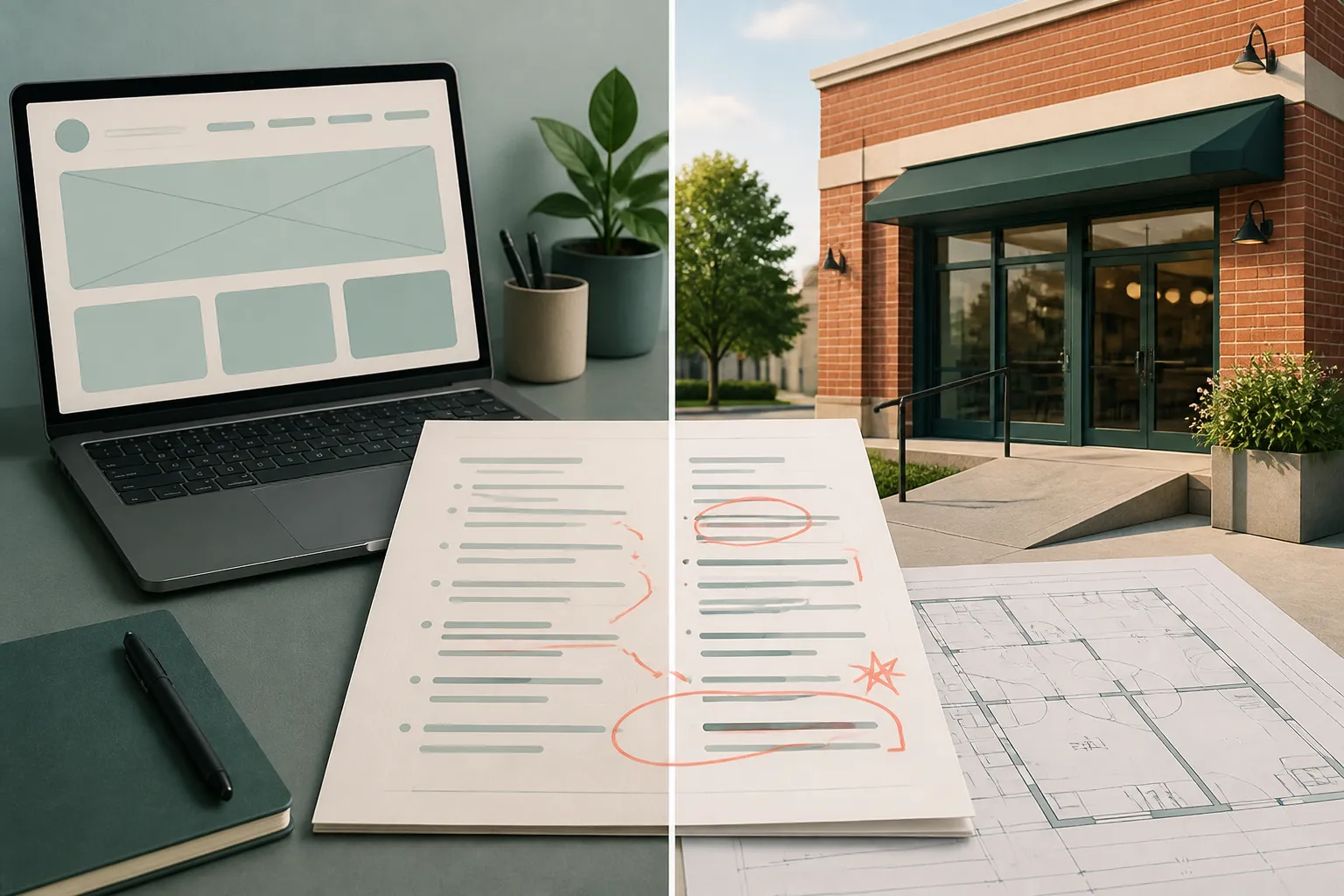
Verdict first: hire for the thing you actually have. A website and a storefront fall under different guidance, and a consultant who is good at one may know little about the other. Most pitches blur that line. Make them draw it.
A building review does not cover your website, and a website review does not cover your storefront. Ask which one you are buying.

Know what you are hiring for: website or physical storefront
The Department of Justice publishes guidance on web accessibility and the ADA. It says businesses open to the public should make their websites accessible to people with disabilities. It covers why this matters, examples of barriers, when the ADA requires accessible web content, and how to fix it. That is the website side.
The storefront is a separate body of rules. The ADA Accessibility Standards apply to places of public accommodation, commercial facilities, and state and local government facilities. The Access Board offers technical guidance on them, including short guides on sales and service counters and maneuvering at doors. Think counter design and the clear floor space around a door. A physical review may look at exactly those things.
So decide first: website, physical site, or both. If a firm says it does "complete ADA compliance" in one line, ask what that phrase includes. Vague bundles are how you pay twice.
Understand which standards apply to your building
The ADA Standards are not the only set of rules. The Architectural Barriers Act (ABA) Standards are a different set, and they apply to federally funded facilities. Most private shops will live under the ADA Standards, but a good consultant should say so out loud instead of assuming.
Age matters too. In California, the state describes the specialist as the person who determines which standards apply, based on the building's age and its history of improvements. Expect that question anywhere. If nobody asks when the building went up or what you have renovated, the review is a template.
One caution for government readers. The DOJ web guidance says it does not reflect the state and local government requirements published in the Federal Register on April 24, 2024. If you run a public entity, check those rules separately. The sources do not say whether they reach a private business.
Check credentials, especially in California
California has a clear credential. A Certified Access Specialist, or CASp, has passed an examination and been certified by the state in the applicability of state and federal construction-related accessibility standards. According to the California Division of the State Architect, only a CASp can provide services that offer "qualified defendant" status in a construction-related accessibility lawsuit. A licensed architect or engineer can do an access compliance evaluation, but without that status.
Qualified defendant status is not a sticker. The state describes it as requiring an inspection of the existing facility, a CASp report, and a compliance schedule in place before a claim is filed. Hiring a CASp in good faith may also lessen a business or property owner's liability. Note the word "may."
Outside California, the sources are silent. They do not cover credentials elsewhere or how to verify them. Check with your state's own accessibility or licensing agency, and be skeptical of any badge you cannot confirm with an issuer.
Ask the right questions before you hire
Cross-examine. A consultant who gets irritated at these questions has told you something.
- Do you hold a state certification, and does it carry qualified defendant status where I operate?
- Will the review cover the ADA Standards, the ABA Standards, or both, and will it account for my building's age and changes?
- Does the work include web content, following the DOJ guidance? What method do you use?
- Will I get a written report and a compliance schedule?
On the web question, know the limit of what is public here. The excerpted sources do not name a technical standard, version, or conformance level, and they do not describe how an audit is run. So ask the consultant to name the standard and explain the method in plain words. If they cannot, move on.
The last question matters most. A report with no schedule is a list of problems you now know about. A schedule is a plan you can show someone.
Plan for cost and possible tax relief
The sources give no consultant fee ranges, so any figure you hear is the seller's. Rates vary by state, building size, and scope. Get written quotes that list exactly what is reviewed, what is delivered, and whether a follow-up visit is included. Compare scopes, not totals. A cheap quote with a thin scope is not cheap.
There is federal help. The IRS describes the Disabled Access Credit, claimed on Form 8826, as a tax benefit to offset the cost of making a business accessible, and the IRS also has a newsroom page on it. The excerpts here do not state the credit amount or who qualifies. Read the current form instructions, and ask a tax professional whether your business fits. This is general information, not tax or legal advice.
Avoid common red flags
- Leaning on an architect or engineer alone when you need qualified defendant status. The California source says only a CASp provides it.
- Assuming a building review covers your website, or the reverse. The guidance is separate.
- Assuming government rules match the DOJ web guidance. The DOJ says it does not reflect them.
- Promises about lawsuits. No consultant can guarantee you will never be sued.
The sources also do not cover lawsuit risk or complaint procedures. For those, use official government resources or a licensed attorney. A consultant is there to assess access. A lawyer is there to advise on liability. Keep the jobs apart, and be wary of anyone who sells both as one tidy package.
Sources
- Guidance on Web Accessibility and the ADA | ADA.gov
- Maneuvering at Doors
- Sales and Service Counters
- Buildings and Sites
- About Form 8826, Disabled Access Credit | Internal Revenue Service
- https://vertexaisearch.cloud.google.com/grounding-api-redirect/AUZIYQFXOy-mMs95HYJcnIxQLuToeezt9_K5ukQmCk4x4CBRdpIlKhWR51H7fXg-6Y36HDkriGyndGTw6RUtSY15M83R-VSiYnxx5Zzqww1LkDpXzNzD6I4SHVCFuH0WMxnWIw==
- Tax benefits to help offset the cost of making businesses accessible to people with disabilities | Internal Revenue Service
- CASp Property Inspection
Still have a question?
Related guides
-

Is That Professional Certification Worth Paying For? Test It Before You Spend a Dollar
Job postings, an independent issuer, and written renewal terms separate credentials that pay off from expensive decoration. By Dolores Kinnane
-

Choosing a Managed IT Provider Without Trusting Blindly
Before you sign, make the provider show what it watches, who acts when something breaks, and who pays when it fails. By Imogen Tarrant
-

What Managed IT Really Costs a Small Business, and Where the Guides Get Vague
Per-user rates look tidy in the headline, but onboarding fees, out-of-scope labor and the provider-written sources behind them tell a messier story.By AnselmRoarke