How to Hire a Commercial Flat Roofer Without Getting Burned
Vet identity, insurance, fall protection, and the written proposal before you let price decide anything.
 By Dolores Kinnane ·
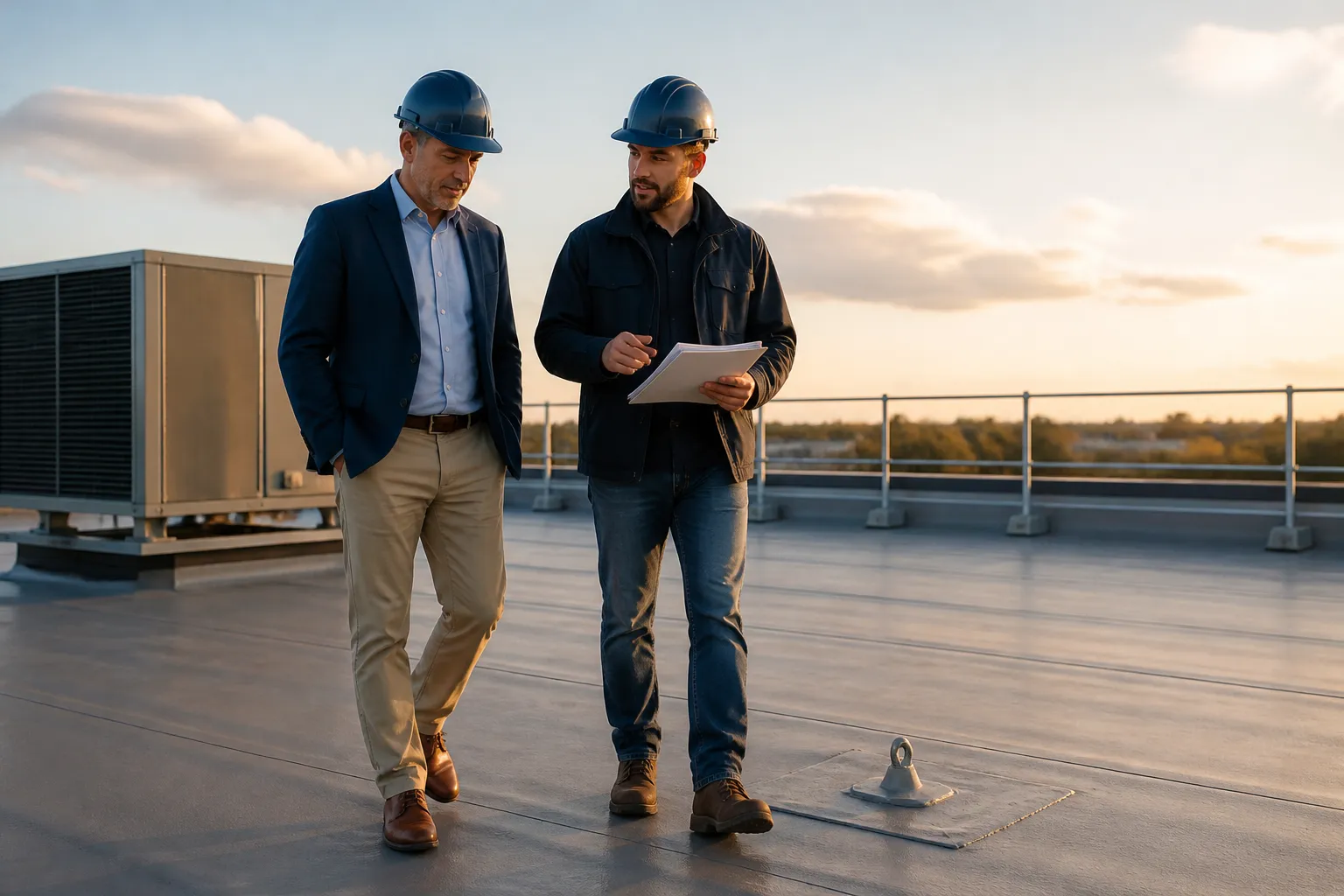
Verdict first: pick the contractor who can prove who they are, show current insurance, explain how they keep people from falling off your roof, and put every promise in writing. Price comes last. Cost ranges for commercial flat roofs swing widely by state, building size, and the existing roof, and the sources behind this guide give no reliable dollar figures, so get several detailed proposals and compare what each includes. This is general information, not legal, financial, or professional advice. A licensed professional should review your actual contract.
If a bid sounds too good to be true, it probably is. The National Roofing Contractors Association says to treat the lowest bid with healthy skepticism.

Start with prequalification and business identity
Do this before you compare a single number. The NRCA recommends prequalifying roofing contractors, and its guidance covers business identity, insurance, references, scope, association membership, Better Business Bureau complaints, supervision, and warranty terms. In plain terms, decide who deserves to bid before you let them bid.
Start with the boring facts. Does the company have a permanent place of business, a working phone number, and a tax identification number? Does it hold a business license where your state or city requires one? A post office box and a mobile number alone are not proof of anything, and they are a reason to ask more questions. Licensing rules for roofers vary by state, and this guide does not cover them. Ask your state licensing board or contractor agency what applies where the building sits. You can read the NRCA's selection guidance here.
Verify insurance and safety practices for a low-slope roof
Ask for copies of current liability insurance and workers' compensation certificates, and confirm both stay in effect for the whole job. A certificate the contractor hands you is a starting point. Checking it with the carrier or a state agency is a separate step, and the sources here do not walk through it. Do it anyway, or ask your own advisor to.
Safety is not a courtesy. Most commercial roofs are low-slope, meaning a pitch of 4:12 or less, and people work near unprotected edges all day. Under OSHA, fall protection for construction work generally starts at 6 feet, while general industry work starts at 4 feet. Ask which standard the contractor follows and how workers are protected at the edge.
OSHA's options for low-slope roofs are guardrails, safety nets, personal fall arrest systems, or a warning line with a safety monitor. The warning line is the weakest, because it depends on people behaving. It must sit at least 6 feet from the edge, stand 34 to 39 inches high, and be flagged at 6-foot intervals. If a contractor relies on it alone where guardrails or fall arrest could be used, that is a warning sign.
Skylights need fall protection at all times, with covers or guardrails. OSHA also expects employers to train workers on hazards and applicable standards, so ask how training is handled. Whether a contractor must hold a particular OSHA certification is not covered here.
Evaluate the written proposal, scope, and design fit
Demand a written proposal. It should describe all the work in full, list specifications, give start and completion dates, and explain payment procedures. A vague proposal is not a minor flaw. It is how you end up unable to hold anyone to anything.
Then ask who will oversee the project, how many workers will be on site, and what quality control steps are planned. A contractor who has thought about supervision answers fast. One who hasn't will talk about "our guys."
Choose on design and fit, not price alone. Industry writing in the IIBEC publication notes that cost-cutting can strip out cover boards, vapor barriers, or adhesives, which can shorten a roof's service life. Watch for proposals that swap these for peel-and-stick alternatives without explaining the consequences. Also ask whether the design accounts for your climate zone and the temperature limits of the products during installation. Membrane types and lifespans are not covered in these sources, so put those questions to the contractor and the manufacturer.
Check warranties, references, and bids
Manufacturer material warranties on roofs are often around 20 years. Many roofs fall short of that. Read the warranty line by line, find the provisions that would void it, and ask what maintenance it requires. A warranty you accidentally void is a brochure.
Ask for a list of completed projects and client references, then actually call them. Ask how the job went and how problems were handled, since every roof job has some. Check whether the contractor belongs to a local, regional, or national roofing association. Membership signals commitment to the industry. It does not guarantee quality. Call the local Better Business Bureau about complaints, and check your state contractor agency too.
Red flags worth walking away over
- An unusually low bid.
- No permanent location, phone number, tax ID, or required license.
- Reluctance to provide references, a detailed written proposal, or insurance certificates.
- Proposals that drop cover boards, vapor barriers, or adhesives without discussing the tradeoffs.
- A warning line and safety monitor as the only fall protection when better options exist.
Contract terms, lien rights, and dispute options are not covered here. Have a licensed attorney look at the agreement before you sign it.
Sources
- Selecting a Contractor - National Roofing Contractors Association
- https://vertexaisearch.cloud.google.com/grounding-api-redirect/AUZIYQG_kOuYfg-m6oKGAOCYdMQtCqCr_6ntls-nwlcIn0Z-wZeUezr433HftVB-cfPWzehPgUcs28lSvUiZvIkwRCEQBEEC7OTeqyY0R5dyfoli-0VA5D9GCpafJtebV3coeU_ZMNTTx7T23blI2wUiv6KwCUHE9W90ydbOSAHR2XSRRC7y5G7pObHQ30kA4V-x9_qnu-Xt5qet4bTE2watBmGwKGO-SZ2GC6-pV2nWP_abdK8YUEP-ALKWSVsVaGsn5kDvkpaKA08s9pVMd_wXr3RB
- Find A Contractor - NRCA
- Finding Balance: The Next Chapter in Low-Slope Roof Design | IIBEC
- International Institute of Building Enclosure Consultants (IIBEC) — RoofersCoffeeShop®
- OSHA Roof Access and Fall Protection Requirements for Commercial Sites
- Commercial Roofing Safety: Precautions & Checklist | Sentry Roofing
- Roofing Fall Protection: OSHA Requirements by Roof Type
Still have a question?
Related guides
-

Is That Professional Certification Worth Paying For? Test It Before You Spend a Dollar
Job postings, an independent issuer, and written renewal terms separate credentials that pay off from expensive decoration.By Dolores Kinnane
-

Choosing a Managed IT Provider Without Trusting Blindly
Before you sign, make the provider show what it watches, who acts when something breaks, and who pays when it fails. By Imogen Tarrant
-

What Managed IT Really Costs a Small Business, and Where the Guides Get Vague
Per-user rates look tidy in the headline, but onboarding fees, out-of-scope labor and the provider-written sources behind them tell a messier story. By AnselmRoarke