Do You Really Need That X-Ray? A Calm Guide to Cost, Timing, and Questions to Ask
Dental X-rays are useful tools with real price tags, and knowing when they are needed and what to ask can make your next visit feel less uncertain.
 By Priya Ranganathan ·

Most of us have sat in the dental chair with that little plastic tab clamped between our teeth, wondering whether this is really needed again. It is a fair question. X-rays are useful, they cost money, and nobody hands you a calendar telling you when the next set is due. Here is a plain look at what they typically cost in the US, how often they come up, and what to ask. Prices vary by state and by practice, so treat the numbers below as a starting point.
You may not need an X-ray at every dental visit. The American Dental Association says they should be taken only when the dentist believes they will give necessary diagnostic information.
Why dentists take X-rays
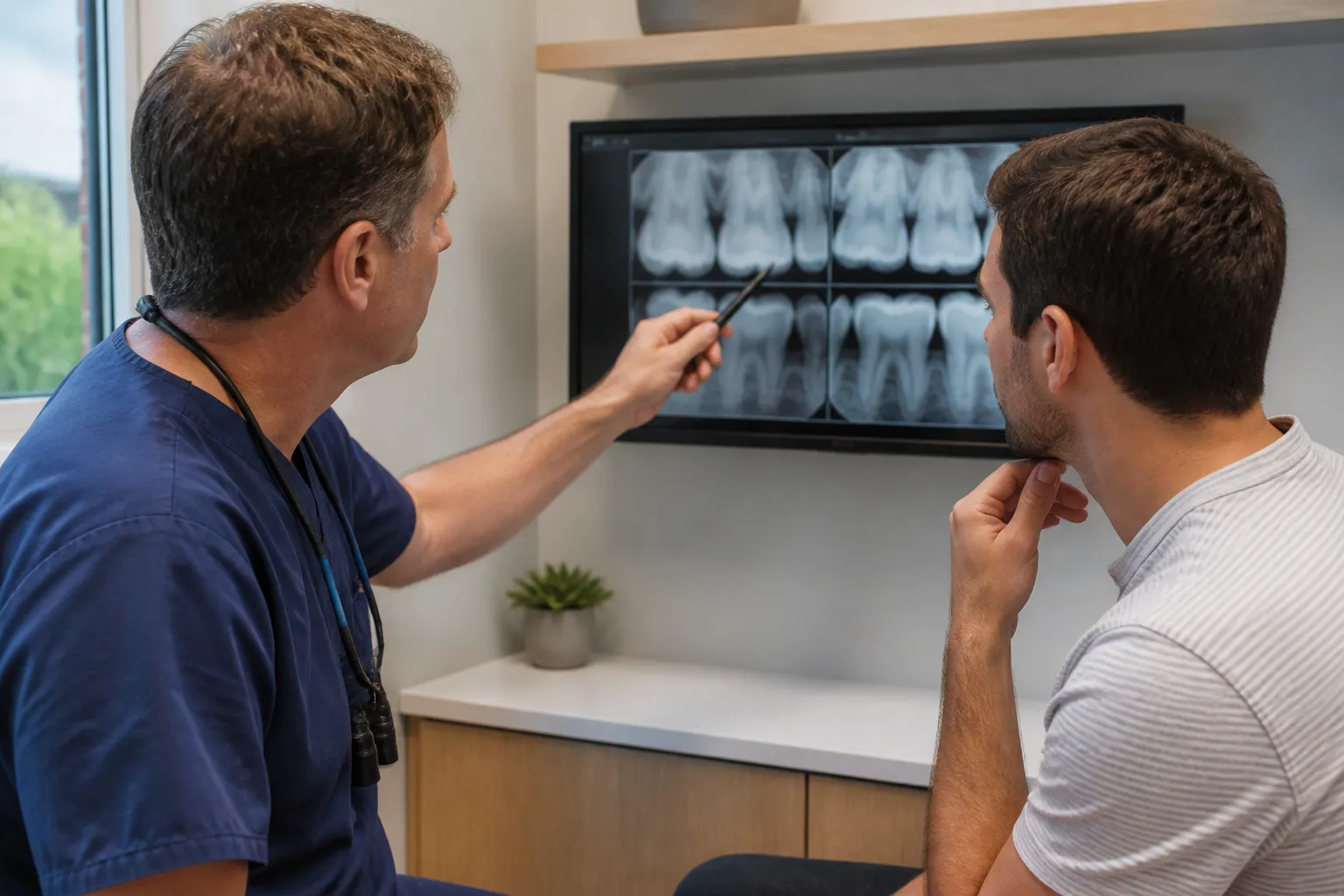
A dentist can see and feel a lot during an exam. What they cannot see is what is happening between your teeth, under old fillings, or inside the bone. X-rays help find new cavities, bone loss, and teeth that are stuck beneath the gum, which are called impacted teeth. So the image is a diagnostic tool, not a formality.
Whether you need one at a given visit depends on your current oral health, your age, your risk of disease, and any symptoms you mention. There is no single schedule that fits everyone. In January 2026, the ADA and the American Academy of Oral and Maxillofacial Radiology published updated recommendations for both 2-D and 3-D (CBCT) images. The message is the same as the 2024 ADA expert-panel guidance: order them when clinically necessary.
What dental X-rays cost
One consumer guide from January 2025 puts the national average at about $52 to $120, depending on the type of image and other factors. That is a broad average, not a quoted price, and your own bill could land outside it.
A membership-plan vendor's guide from the same month breaks it down further. Without insurance, it lists these typical ranges:
- Bitewing: $20 to $100
- Periapical (a close view of one or two teeth): $25 to $100
- Full-mouth set: $100 to $300
- Panoramic: $100 to $250
- 3D cone beam CT: $150 to $750
With insurance, the same source lists lower figures, such as $10 to $50 for a bitewing and $75 to $500 for a 3D scan. Keep in mind this comes from a commercial source, not a regulator, so it is a rough guide. The 3D pricing in particular rests on that one source.
Prices shift by state, city, and practice. The sources I found give only national figures and do not say what drives the regional differences. The simplest fix is a phone call. Ask your own office for the fee, and if you have time, ask one or two others.
How often X-rays are typically taken
You will see rules of thumb online. One dental practice's blog suggests children every one to two years, adults with good oral health every two to three years, and adults with a history of disease as their dentist recommends. That is one practice's view, not an ADA standard.
Because the ADA ties timing to clinical need, the most accurate answer usually comes from your dentist. They should look at your medical and dental history, any earlier images, and the current exam. The material I reviewed does not spell out the specific interval rules in the 2026 recommendations, so please do not assume a fixed number of years.
On safety, dental X-rays use very low doses of radiation, and the risk of harm is very small. Doses have dropped a great deal as technology improved. Practices follow the ALARA principle, which means as low as reasonably achievable. Each exposure should be justified by its benefit.
How to manage cost and coverage
Start with your dental plan, before the visit. Many plans cover X-rays as part of a routine exam, but coverage varies. The sources do not say what plans typically pay or how many X-rays they allow in a year, so ask the plan directly.
Online cost estimators can help you plan. One large dental insurer's tool says plainly that it does not guarantee fees, what your plan will cover, or your out-of-pocket cost. Think of an estimate as a rough map, not a quote.
Fees differ between providers, and community dental clinics may offer reduced-rate X-rays. In-office membership plans are sometimes promoted as a way to save. They are not insurance, and each practice sets its own included care, pricing, and terms. Ask for those in writing. Medicare and Medicaid coverage for dental X-rays, and state radiation rules, were not covered in the sources, so check with the program or your state agency.
Questions to ask and red flags
A few calm questions go a long way:
- Why do I need this X-ray now, and what will it show that the exam cannot?
- Do you already have images from my previous dentist? A new dentist can often request copies instead of retaking them.
- What will this cost with my insurance, and what without it?
- Do you use leaded shielding, and why or why not? Current ADA guidance says aprons and collars are no longer needed for patients of any age, including during pregnancy, though some offices still use them because of local rules.
Some things deserve a second look. X-rays at every visit with no stated reason go against ADA guidance. A membership plan described as insurance is a red flag. Claims like "save 20% to 50%" or free X-rays for new patients should be confirmed in writing. And an estimate is not a guaranteed fee.
If a recommended X-ray is out of reach, ask about payment options and community clinics, and confirm the cost before the procedure. This is general information, not medical, legal, or financial advice. A licensed dentist can speak to your own situation.
Please seek a professional. This article is general information, not medical advice. Please seek a doctor or other qualified health professional about your own situation. In an emergency, call 911 or your local emergency number.
Sources
- X-Rays/Radiographs | American Dental Association
- New Recommendations Confirm Dental X-Rays Most Effectively Used in Moderation | American Dental Association
- X-rays | MouthHealthy - Oral Health Information from the ADA
- https://vertexaisearch.cloud.google.com/grounding-api-redirect/AUZIYQE4TDQVO4obo9xpi7u_LrRqF1S-CEfLUhexoDd3mCBtAQnbSBhR09YJCsyccXx4bgwc1c7C9oy9be37Uitd5HZyR44pQV8mtYbVL0nJKDhphDjRlOCH8QRa1QkEqIAQ
- Dental X-Rays: Safety First! How Often Should We Get Them? - Belmont Dental Associates
- Dental X-rays: Key Things to Know | Delta Dental
- How Much Do Dental X-Rays Cost? Prices by Type and Location
- How Much Do Dental X-Rays Cost? A Complete Guide
Still have a question?
Related guides
-

Clear Aligners Without the Hype: What to Check Before You Start
Mail-order trays look simple, but the FDA says safe treatment still depends on in-person supervision by a licensed dental professional.By Priya Ranganathan
-

Save the Tooth or Pull It? A Careful Look at the Choice
Root canals and extractions differ in more than the first price you hear, so it helps to compare the full path, the recovery and the questions worth asking your dentist. By Lorraine Whitcombe
-

Dentures or Implants: How to Weigh the Choice
A plain-language guide to how conventional and implant-supported dentures differ in comfort, upkeep and cost, with the questions to bring to your dentist.By Priya Ranganathan