What a Dental Bone Graft Costs, and What the Numbers Leave Out
Prices for grafts and sinus lifts vary widely by material, location, and the details of your jaw, so a written quote is the most reliable place to start.
 By Walter Pemberton ·
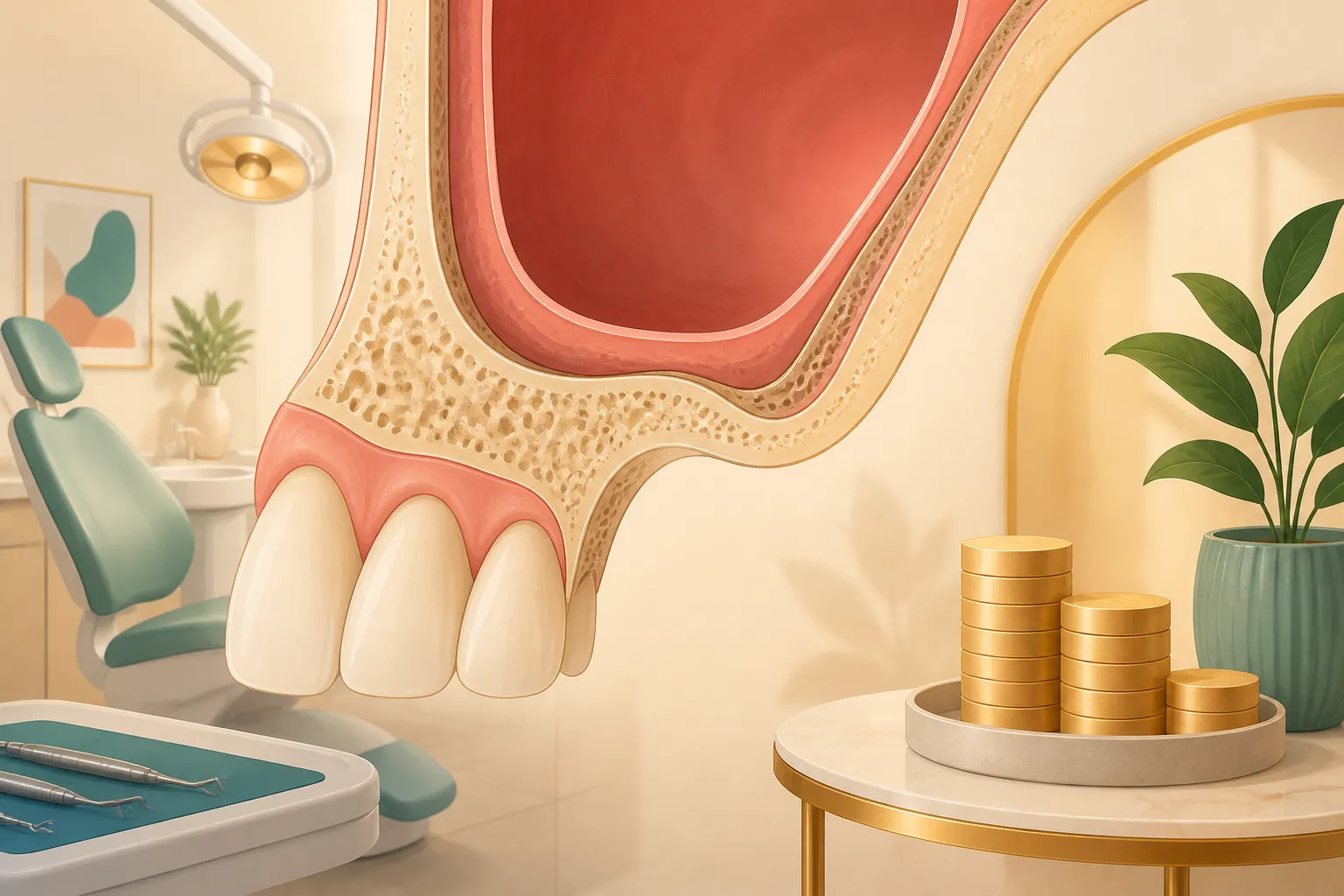
Picture a neighbor who finally decides to replace a missing back tooth. The dentist takes a scan, studies it for a moment, and says the bone is too thin for an implant. Not yet, anyway. First comes a bone graft, maybe a sinus lift. Then comes the question that follows people home: what is that going to cost?
This guide walks through the numbers gently, with the caveat up front that they are national snapshots. Prices vary by state, by city, and by the details of your mouth. Nothing here is personal medical, legal or financial advice, and a licensed dentist or specialist can speak to your own situation.
What these procedures are
A dental bone graft rebuilds jaw bone that has been lost or has grown thin. That often has to happen before an implant, because the implant needs something solid to anchor in. A sinus lift, also called sinus augmentation, is one particular kind of graft. It raises the floor of the sinus to create bone in the upper back jaw, where the sinus sits close to the roots of the teeth.
Other grafts exist too, such as socket preservation after an extraction or ridge augmentation to widen the jaw. Because the goal and the surgical site differ, a quote for one may not cover another. It is worth asking, plainly, which procedure is being priced.
A general dentist, a periodontist, or an oral surgeon may do the work. Periodontists and oral surgeons are commonly trained in it, which is a fair thing to weigh when you compare offices.
What it typically costs in the US
One widely cited 2024 cost study, reported by a healthcare financing company, puts the average dental bone graft at about $549 to $5,148 per graft. That is a wide spread, and graft type explains most of it. Donor or synthetic material averages roughly $549 to $1,575 per graft. Your own bone, taken from another spot in your body, averages about $2,161 to $5,148.
Another source gives a somewhat different picture: about $300 to $3,000 per area treated. In that breakdown, synthetic or animal-derived material runs $300 to $800, donor bone $700 to $1,500, and your own bone $2,000 to $3,000. The sources do not match exactly, and that is normal. They measure different things in different places.
Location matters as well. Prices are reported to run higher in big cities and coastal states. The most honest guide to what you would pay is a written quote from an office near you.
How the procedure works and why the timeline matters
In a common sinus lift technique, the gum is opened and a small piece of bone is lifted into the sinus cavity, a bit like a trap door. The space underneath is then filled with graft material. That material can be donor bone from a licensed bank, a lab-made product such as hydroxyapatite, your own bone, or animal-derived bone, often bovine or porcine.
Time is the part people tend to underestimate. Initial healing takes about a week, but full healing can take up to a year. The bone is usually left to develop for four to 12 months before implants go in, though sometimes the implant can be placed at the same time.
How a graft gets decided
A sinus lift is generally considered when bone height in the back of the upper jaw is under about 4 to 6 millimeters. A cone beam CT scan is commonly used to measure this. The scan is what tells you whether a graft is needed at all, so it is reasonable to ask to see it and have it explained.
That matters because a graft is not automatic. One cited paper suggests only roughly one in four implants needs one. If someone says every implant needs a graft, without pointing to imaging, take a breath and consider a second opinion.
How to compare quotes and what to ask
Start with the material, since it drives most of the cost spread. Then ask whether a second surgical site is involved. Using your own bone means a hip or chin procedure too, which changes both price and recovery.
- Which graft material is recommended, and why?
- Is the sinus lift a separate charge from the graft, or one procedure?
- How many areas does the quote cover?
- Will the implant go in at the same time, or after healing, and how long is that wait?
- Is a cone beam CT scan planned, and what does it show?
A quote that names no graft type and no number of areas is hard to compare with anything. Politely ask for those details in writing.
What these figures do not cover
The sources here say little about insurance, your out-of-pocket share, or financing terms. Call your plan and the office directly. They also do not give the total for the finished implant after grafting, or the cost of follow-up visits and imaging. An itemized estimate that lists each of these is a sensible request.
Recovery, pain management, and complication rates are only briefly described, so those are good questions for the surgeon. To check a provider's license, your state dental board is the right place to start. For a sense of scale, a routine exam with cleaning and X-rays averages about $203 nationally, which shows how different a graft is from everyday dental care. Take your time, and bring your questions with you.
Please seek a professional. This article is general information, not medical advice. Please seek a doctor or other qualified health professional about your own situation. In an emergency, call 911 or your local emergency number.
Sources
- Sinus Augmentation - American Academy of Periodontology
- Dental Bone Graft: Process, Purpose & Healing
- Dental Bone Graft Cost and Procedure Guide
- How Much Does Dental Bone Grafting Cost? | 815 Dental Studio
- Dental Bone Graft Cost: What It Is & What You'll Pay
- Gum Disease: Causes, Symptoms, Treatments and Costs - CareCredit
- Dentist Prices: Dental Procedure Cost List - CareCredit
- Sinus Lift: Procedure, Cost, Recovery, and More
Still have a question?
Related guides
-

Clear Aligners Without the Hype: What to Check Before You Start
Mail-order trays look simple, but the FDA says safe treatment still depends on in-person supervision by a licensed dental professional. By Priya Ranganathan
-

Save the Tooth or Pull It? A Careful Look at the Choice
Root canals and extractions differ in more than the first price you hear, so it helps to compare the full path, the recovery and the questions worth asking your dentist. By Lorraine Whitcombe
-

Dentures or Implants: How to Weigh the Choice
A plain-language guide to how conventional and implant-supported dentures differ in comfort, upkeep and cost, with the questions to bring to your dentist.By Priya Ranganathan