Tank or Tankless? How to Compare Water Heater Bids on Equal Terms
Learn how tank and tankless units differ, and which details a written plumber's quote should spell out so three bids can be compared fairly.
 By Renata Okafor ·

Is your water heater leaking, rusting, or just old, and are you wondering whether to swap in another tank or move to a tankless unit? Before you call anyone, it helps to know how the two types differ and what a written quote should spell out, so that three bids can be compared on equal terms. This guide is general information only, not personal financial or home-repair advice, so confirm details with a licensed plumber in your area.
How tank and tankless units work
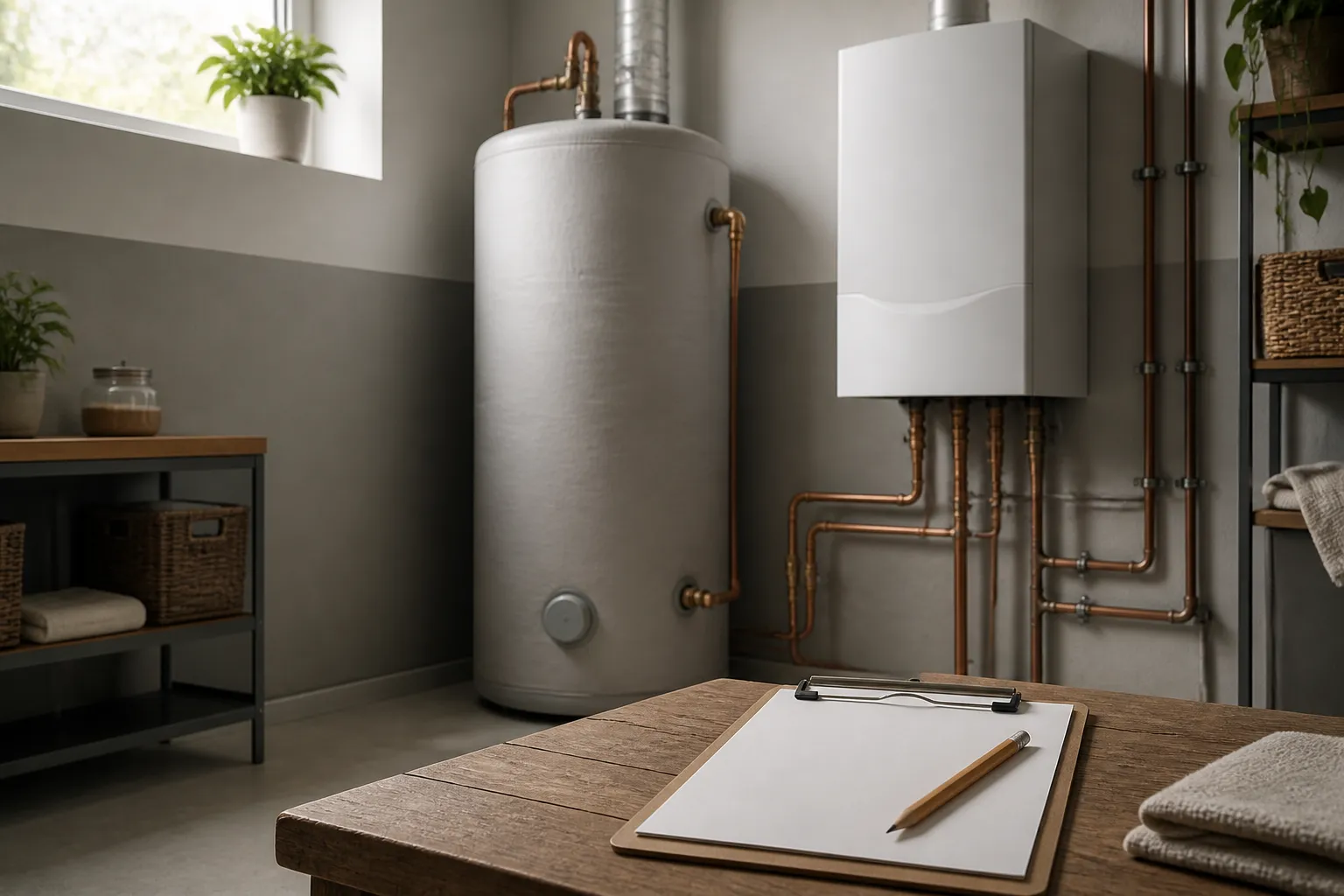
A tank water heater keeps a large volume of hot water in storage so it can be drawn quickly. Because that water stays heated around the clock, the tank loses some heat even when nobody is using any. That loss is called standby loss.
A tankless, or on-demand, unit has no storage tank. When a hot water tap opens, a sensor detects the flow and the unit heats the water to a preset temperature. A gas tankless model contains a high-powered burner, a fan, and a heat exchanger. It uses energy only while water is flowing, which is how it avoids standby loss. According to the Building Science Education material, tankless units are small and tend to outlast tank units, though that source gives no specific lifespan numbers.
Efficiency and energy use
Water heating can take 19% to 32% of a homeowner's utility bill, according to the Energy Information Administration. Note what that number is. It is a share of your monthly bills, not a price for equipment or installation.
If you stay with a tank, a high-efficiency gas storage model is one way to cut that share. These units tend to have better insulation, heat traps, and more efficient burners than standard ones. The sources do not put a percentage on savings for tank versus tankless, so ask your plumber, or check a current Department of Energy resource, before you trust anyone's promise of a specific figure.
- Ask what efficiency rating each quoted unit carries.
- Ask how the installer estimated any savings.
- Treat a single big savings number with caution.
Choosing between tank and tankless
Start with demand. A high-efficiency tankless unit delivers about 2 to 5 gallons per minute. If a shower, a dishwasher, and a laundry cycle often run at once, ask whether one unit can handle that peak or whether you would need more than one. The sources do not explain sizing methods, so this is a question for the installer.
Then look at venting, which matters for safety. For gas storage units, a sealed-combustion, direct-vented design is recommended. It draws combustion air from outside and vents exhaust outside, which the sources say makes backdrafting of flue gases into the house almost impossible. A high-efficiency power-vented unit is an alternative that can also avoid backdrafting.
- Count how many hot water uses overlap in your busiest hour.
- Check what fuel and venting you have now.
- Ask each bidder to explain how their unit meets that peak.
What a plumber's quote should include
A good quote is specific enough that you could hand it to a different plumber and get the same job priced. Look for these items, each on its own line:
- Equipment: make, model, capacity or flow rate, and efficiency rating.
- Labor: itemized apart from equipment.
- Removal and disposal: a clear yes or no for the old unit.
- Venting, gas line, electrical, condensate, and water connections: separate lines, since these are common sources of extra charges.
- Permits and inspections: who pulls the permit and who pays.
- Warranty: equipment and workmanship terms, in writing, with what each covers and for how long.
The sources do not say which agency enforces installation or permit rules, so call your local building department. They also give no typical warranty lengths, so compare what each bidder puts on paper.
Costs and checking the installer
The sources reviewed give no price ranges for replacing a tank or a tankless unit. Real US costs vary by state, local labor rates, code requirements, and the condition of your existing venting and piping. Tankless jobs often involve extra gas, venting, or electrical work, so expect that to show up as separate lines. Check current figures from your state or local consumer sources before you set a budget.
When bids arrive, line them up on the same terms: equal capacity or flow rate, equal efficiency rating, and the same venting approach. A lower price on a different unit is not a like-for-like comparison. Then confirm the installer holds the license your state or locality requires, using your state licensing board's public lookup. If you are thinking about changing fuel types, ask for a separate quote showing the added gas, electrical, or venting work. The sources do not cover electric models or conversion costs.
Quick recap
Sources
Still have a question?
Related guides
-

Upgrading to 200 Amps Without the Surprise Bill
Panel costs are only part of the story, so here is what a 200 amp upgrade typically runs, what can get added on, and what to ask before you sign. By Neil Ostrander
-

Find the Water First: A Practical Guide to Deciding on Mold Testing and Cleanup
Before anyone runs a sample or quotes a job, the moisture source and the size of the visible patch settle most of the decision. By Gideon Aldaine
-

When Your Contractor Doesn't Pay, Your House Might Pay Instead
Paying your contractor in full may not close the book on a mechanics lien, so collect the paperwork and confirm the rules in your state before the work starts.By Neil Ostrander