Before You Buy or Gut an Older Home: Testing, Removal Costs and Who to Call
Find out whether suspect materials contain asbestos first, then plan the budget around accredited testing and removal.
 By Neil Ostrander ·
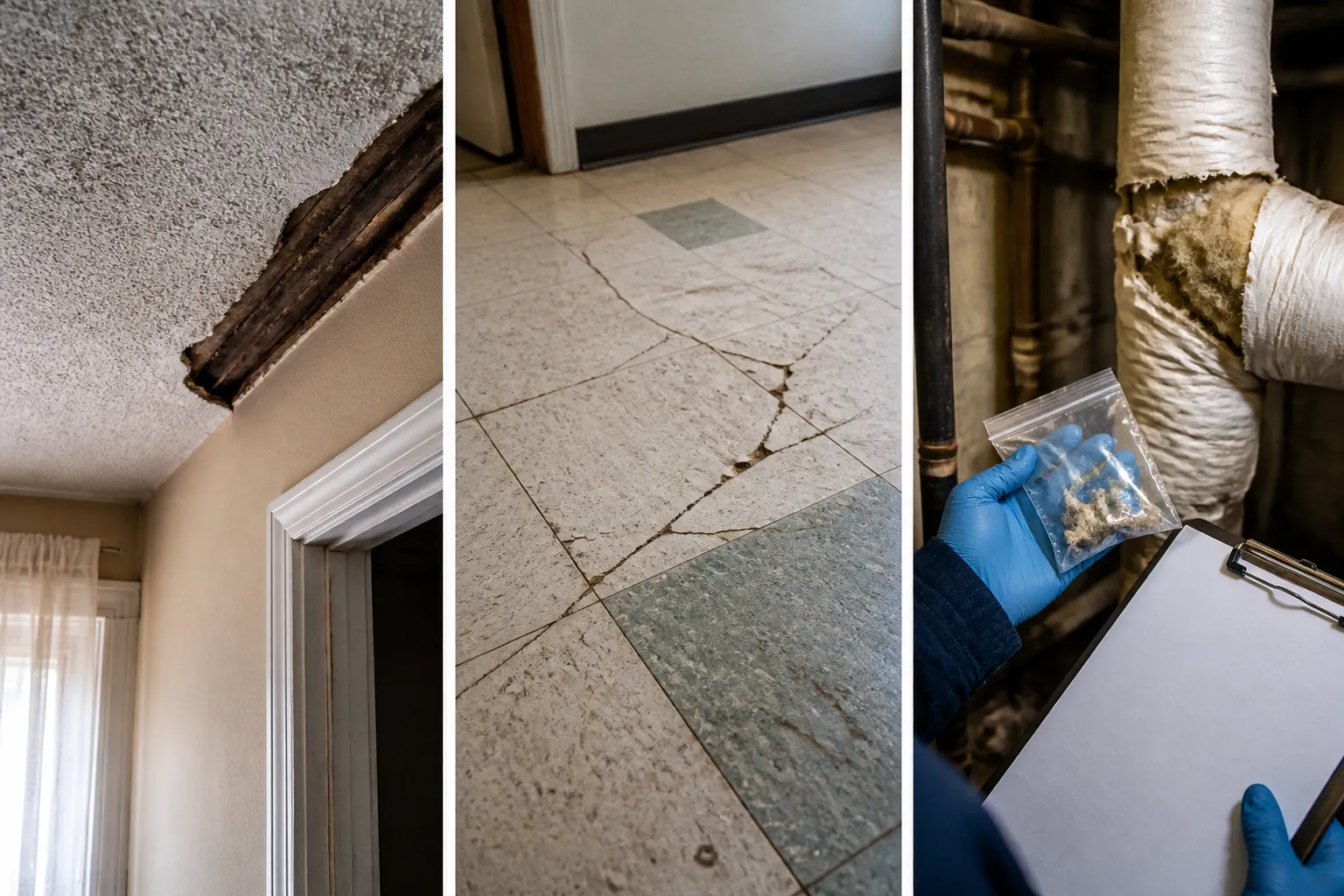
Found an old popcorn ceiling, cracked floor tiles, or pipe wrap in a house you are about to buy or gut? Then you are probably asking two questions at once: is it asbestos, and what will this cost? This guide takes them in order, because the first answer decides the second. Figures below are national or single-market estimates, and prices vary by state and locality. This is general information, not personal medical, legal or financial advice, so check with a licensed professional and your state agency before you act.
Why testing comes before any price talk
You generally cannot tell whether a material contains asbestos by looking at it, unless it is labeled. The EPA's advice is simple: if you are in doubt, treat it as asbestos and leave it alone. Homes built before 1980 are the most likely to contain it, since asbestos was widely used through the late 1970s. Common suspects include:
- Spray-applied fireproofing and textured (popcorn) ceilings
- Vinyl floor tiles and their adhesive
- Pipe insulation and duct wrap
- Roof shingles and joint compound
Do you have to test at all? Not always. The EPA says that if building materials are in good condition and will not be disturbed, you do not need to have your home tested. Testing matters more before a remodel, a demolition or a real estate transaction, or when materials are crumbling, damaged or falling apart. Fibers can be released when material is disturbed, cut, torn, sanded or repaired.
One firm rule: let a trained, accredited professional take the samples. The EPA does not recommend doing it yourself, because sampling done wrong can be more hazardous than leaving the material alone.
What asbestos testing costs
A national consumer cost guide puts typical residential testing at roughly $231 to $776, with an average near $483. Another source lands at about $250 to $750, averaging around $500. Those two agree well enough to give you a sensible planning range.
The price depends on what kind of test you need. Typical ranges look like this:
- Air testing: about $200 to $800
- Dust sampling: about $120 to $180
- Material (physical) sampling: about $250 to $750
- Full-home inspection or survey: $250 up to $850 or more, depending on scope
The number of samples drives the total, which is why property size and condition matter. Larger homes, commercial properties and rush turnaround can push testing above $1,500. One industry estimate lists additional samples at $25 to $75 each. So ask how many samples a quote includes before you compare it with another. Again, these are national or single-market figures, and your state and town may differ.
What asbestos removal costs
A home improvement cost guide gives a typical removal range of about $1,192 to $3,240, with a national average near $2,201. Treat that as a broad benchmark, not a quote for your project. A small patch of floor tile and a whole basement of pipe insulation are very different jobs.
What moves the price? Mostly these things:
- The type of asbestos-containing material
- The size of the affected area
- Location in the home and how hard it is to reach
- Preparation, labor, materials and equipment
- Cleanup and disposal fees
Disposal fees vary by state, so a low headline number may leave them out. Ask for them in writing.
Removal is hazardous work best left to professionals with the right experience and protective equipment. Some states prohibit homeowners from removing asbestos themselves, so do not assume a do-it-yourself job is even legal where you live.
Rules that can add fees and paperwork
Federal NESHAP rules under the Clean Air Act set work practices for asbestos during demolitions and renovations of most buildings. Residential buildings with four or fewer dwelling units are excluded. State and local agencies may have stricter standards, so a small house may still face local rules.
Illinois shows how this can look. Its state EPA enforces the rules by delegation and asks for a $150 notification fee, plus a $6.00 convenience fee for electronic payment, along with a project notification form 10 working days before a regulated demolition or renovation starts. Paying the fee alone does not establish compliance. Your state may handle all of this differently.
How to choose a professional and what to ask
Start with the credential. For sampling, look for a trained, accredited asbestos professional. For regulated school, public or commercial work, workers, inspectors, management planners and project designers must be accredited under a program at least as stringent as the EPA Model Accreditation Plan. Training and licensure rules differ by state, so call the state agency that oversees asbestos. Illinois, for example, points training and licensure questions to its public health department.
Before you sign, work through this checklist:
- Are you accredited under a program at least as stringent as the EPA Model Accreditation Plan?
- Are samples taken by trained, accredited staff and analyzed by a certified lab? (Labs typically use polarized light microscopy or transmission electron microscopy.)
- Does the quote cover the on-site inspection, sample collection and lab analysis?
- How many samples are included, and what does each extra one cost?
- Has the required state notification been filed before renovation or demolition?
Get at least two quotes and compare them line by line, not just by the bottom number.
Red flags and limits of this guide
Walk away, or at least pause, if you see any of these:
- Advice to take your own samples
- Removal by unaccredited workers where accreditation is required
- Missing or late required notifications, which can bring added fees or penalties
- Quotes that leave out disposal or lab analysis
This guide does not cover state-by-state pricing beyond the sources cited, insurance coverage or financing, detailed ways to verify accreditation or lab certification, what to do after a positive result beyond general advice, or the health risk of any specific exposure. For those, contact your state asbestos agency or a qualified licensed professional. Written quotes, a short list of questions and a call to the state office will save you more than any price table.
Sources
- Protect Your Family from Exposures to Asbestos | US EPA
- Asbestos
- Information for Owners and Managers of Buildings that Contain Asbestos | US EPA
- How Much Does Asbestos Testing Cost [2025 Data]
- How Much Does Asbestos Removal Cost in Atlanta? (And What Affects the Price) - BioRestore Asbestos & Mold
- Factors and Considerations That Go Into Asbestos Removal Cost
- Asbestos Testing Cost: Full Price Breakdown | iBuyer.com
- Costs of Asbestos Testing 2025 – The Asbestos Institute
Still have a question?
Related guides
-

Upgrading to 200 Amps Without the Surprise Bill
Panel costs are only part of the story, so here is what a 200 amp upgrade typically runs, what can get added on, and what to ask before you sign.By Neil Ostrander
-

Tank or Tankless? How to Compare Water Heater Bids on Equal Terms
Learn how tank and tankless units differ, and which details a written plumber's quote should spell out so three bids can be compared fairly. By Renata Okafor
-

Find the Water First: A Practical Guide to Deciding on Mold Testing and Cleanup
Before anyone runs a sample or quotes a job, the moisture source and the size of the visible patch settle most of the decision. By Gideon Aldaine