Hire a General Contractor or Build as Owner-Builder? What to Weigh Before Work Starts
Choosing between a single licensed contractor and running every trade yourself comes down to who holds the permits, who answers for defects, and how much time you can give the job.
 By Renata Okafor ·
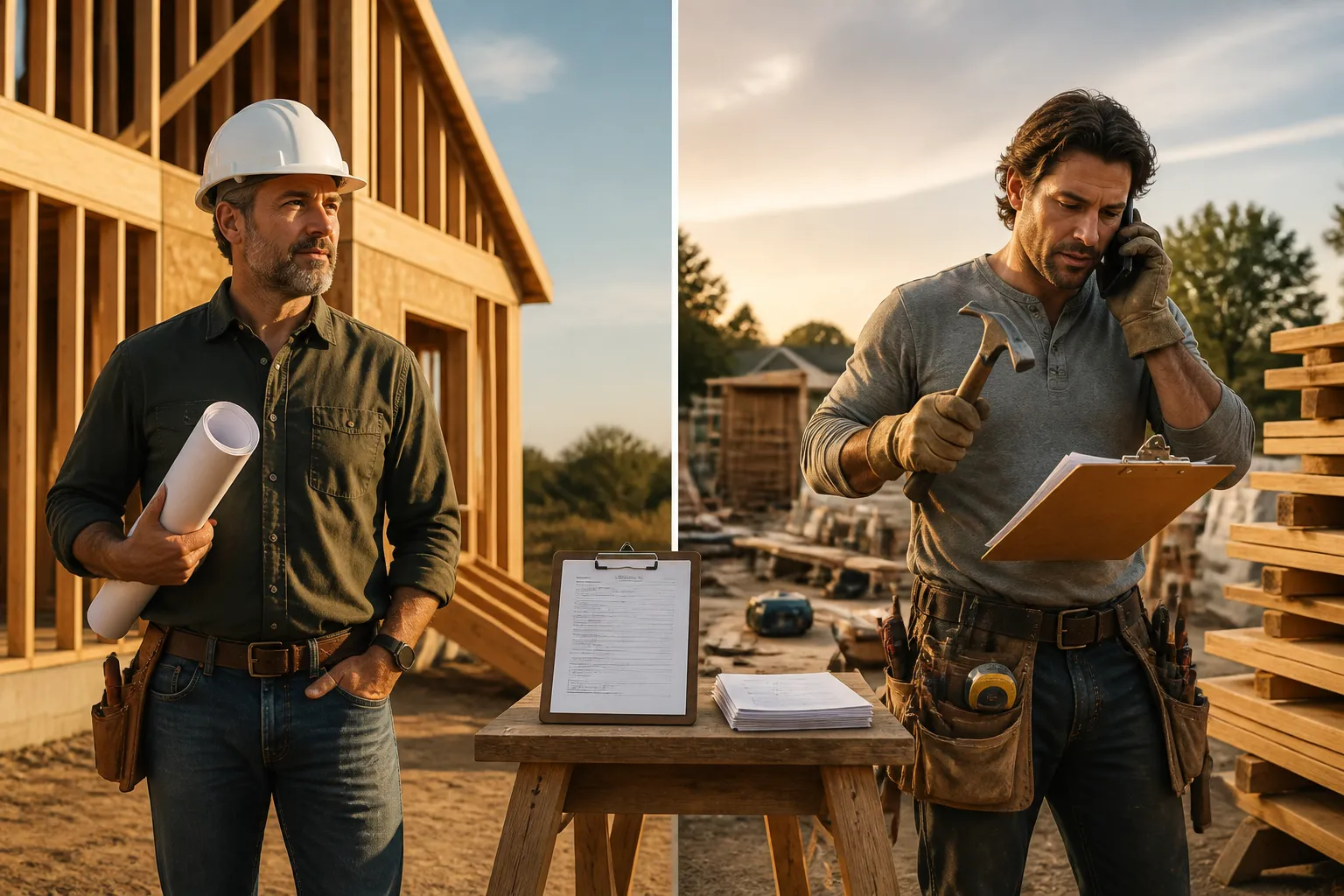
Should you hire one company to run your build, or act as your own general contractor and line up every trade yourself? It sounds like a simple money question. It is really a question about who holds the permits, who answers for mistakes, and how many hours a week you can give the job. This guide walks through both paths, the costs, and the checks to make before any work starts. It is general information only, not legal, financial or personal advice, so run your plan past a licensed professional in your state.
The two paths in plain terms
With a general contractor, you sign with one licensed company that takes responsibility for the whole job. That company hires and supervises the trades it needs. You still approve the plans, the budget and any changes, but you do not chase each electrician, plumber or framer yourself.
With the owner-builder path, you are the general contractor. You hire and supervise subcontractors, buy materials, schedule inspections, pull permits and make sure the work meets code. Some owners mix the two, hiring a contractor for the structure and handling finishes alone, or the reverse. A hybrid only works if you settle three things in writing:
- Who holds the permits.
- Who is licensed for each piece of work.
- Who answers for defects.
One caution. Many of the sources behind this guide describe California law. Owner-builder exemptions, permit rules and license requirements differ by state, so check your state licensing board and local building department first.
What owner-builder responsibility really includes
An owner-builder takes full responsibility for every phase of the project and its integrity. If something is built wrong, an inspection is missed or the schedule slips, the owner answers for it, not a contractor.
The core duties are easy to list and slow to do well:
- Hire and supervise the subcontractors.
- Pay for materials and supplies.
- Arrange every required inspection.
- Obtain permits in your own name or your business entity's name.
- Confirm the work follows building codes.
Exemptions also come with limits. In California, for example, the owner-builder exemption generally requires the site to be your principal residence, and it caps how many structures you can build in a set period. Some trades, such as well drilling, are off limits to owners doing their own work. Confirm what applies where you live before assuming you qualify.
The biggest trap is hiring people who are not properly licensed or insured. If a worker is hurt and lacks workers' compensation, the owner can be asked to cover the costs through a homeowner's policy or face a lawsuit. You can also be treated as an employer if you hire anyone other than a licensed contractor or family member, which brings tax withholding and insurance duties.
Where the cost difference comes from
A general contractor charges for labor and materials plus overhead and profit. Owner-building can trim that overhead, but only if you supervise well, buy materials sensibly and avoid rework. Labor is the big lever. A National Association of Home Builders report, cited by a log home industry group, puts labor at about 60 percent of the cost to build. Doing some work yourself may cut that, but only for work you can legally and competently perform.
I can't give you a trustworthy dollar range here. The sources do not state current prices or a typical contractor markup, and costs swing widely by state, region and project type. The practical fix is to collect written bids from several licensed contractors and compare them line by line, not to rely on a rule-of-thumb percentage.
Then count the costs that never show up on a bid:
- Time away from your regular job.
- Delays while you wait on inspections.
- Fixing mistakes.
- Insurance and workers' compensation if you have employees.
- Mechanics liens if a subcontractor or supplier is not paid on schedule.
How to choose and verify before work starts
Start with an honest look at your own experience. Owner-building suits people who already understand sequencing, codes and how the trades depend on each other. Without that, mistakes cost money and take time to undo.
If you hire a general contractor, work through this checklist before signing:
- Confirm the license is active with your state board.
- Look up complaints or disciplinary history.
- Confirm liability insurance and workers' compensation, and ask the insurer for certificates directly.
- Confirm the contractor will pull permits as contractor of record.
- Ask your lender whether a licensed professional is required, and get the answer in writing.
That fourth step matters more than it looks. If a contractor asks you to pull permits in your name, you may legally become the owner-builder, whether or not you meant to. The lender question matters too, because some lenders will not fund a project without a licensed contractor involved.
Questions to put to any contractor or subcontractor
Keep this list in your phone and ask every bidder the same things. Write down the answers so you can compare them later.
- Are you licensed, bonded and insured, and do your subcontractors carry liability insurance and workers' compensation? Get license numbers and check them yourself.
- Who pulls the permits, and in whose name?
- Who schedules inspections, and who certifies the building is ready to occupy?
- What is in the scope: shell only, or a complete turnkey job with finishes, site work and utilities?
- What are the payment schedule, the change order process and the warranty?
The sources here do not explain contract terms in depth. Have a qualified professional review the contract before you sign it.
Red flags to watch for
Be wary of consultants or unlicensed people who push you to become an owner-builder to save money. Regulators warn that they are often the ones who profit, while you carry the risk. Anyone who charges a fee to guide you through the owner-builder process without a license may be breaking the law.
Slow down if you see any of these:
- A request to pull permits in your name.
- Big savings promised with no mention of liability.
- Pressure to pay a large amount up front.
- Vague bids.
- A refusal to show proof of license or insurance.
Federal consumer guidance on home improvement scams recommends checking these basics before any money changes hands. If something feels off, get a second bid and a second opinion.
Sources
- Owner-Builder Risks - CSLB
- Owner-Builder Risks - CSLB
- What are some of the risks owner-builders may face?
- The Dangers of Acting as an Owner-Builder - CKB Vienna LLP — CKB Vienna LLP
- How To Avoid a Home Improvement Scam | Consumer Advice
- https://vertexaisearch.cloud.google.com/grounding-api-redirect/AUZIYQGxHrERrgNiXYWDxLD6d1je6VbylpcVonlwtSvKHVLjiVTM191dGTsaH9nD8B54r7gAR95-eA4S_9VmhUeX7DFHtdVu_dToCeYR-je34JfGjzmm21ovCy0oytVkDtdj0FOVw0NJNYMCPV9tYfc76Ezk5miOif3atrdUustwFAPq4VuzaFeZI-Xdl5MawwPPukIA
- How to Choose a Builder | NAHB
- How to Choose a Log-Friendly Lender | NAHB
Still have a question?
Related guides
-

Upgrading to 200 Amps Without the Surprise Bill
Panel costs are only part of the story, so here is what a 200 amp upgrade typically runs, what can get added on, and what to ask before you sign. By Neil Ostrander
-

Tank or Tankless? How to Compare Water Heater Bids on Equal Terms
Learn how tank and tankless units differ, and which details a written plumber's quote should spell out so three bids can be compared fairly.By Renata Okafor
-

Find the Water First: A Practical Guide to Deciding on Mold Testing and Cleanup
Before anyone runs a sample or quotes a job, the moisture source and the size of the visible patch settle most of the decision. By Gideon Aldaine