How to Judge a Rooftop Solar Quote and Verify the Installer Behind It
Compare bids line by line, account for the federal tax credit change, and confirm the installer's certification before you sign anything.
 By Renata Okafor ·

What should a rooftop solar system cost, and how do you know the company quoting it is the real thing? Those two questions sound separate, but they get tangled fast. A low price from an installer you cannot verify is not a bargain, and a polished pitch does not tell you what the credit change did to your net cost. This guide walks through both, step by step, with the checks I would run before signing anything.
What solar costs and why the number is harder to pin down right now
I would love to hand you one clean dollar range per watt or per system. The sources I could verify for this guide do not provide one, and I would rather say so than invent a figure. Costs in the US vary by state, by utility, by roof, and by system size, so treat any number you read, including ones in ads, as a starting point to check against recent local quotes.
What the market data does show is the direction of equipment pricing. EnergySage reports that residential solar and storage prices hit all-time lows after a strong 2024, and that the first half of 2025 brought mixed results. Cheap hardware still does not guarantee a cheap finished job, because labor, permitting, roof repairs, and electrical upgrades all land on the final bill.
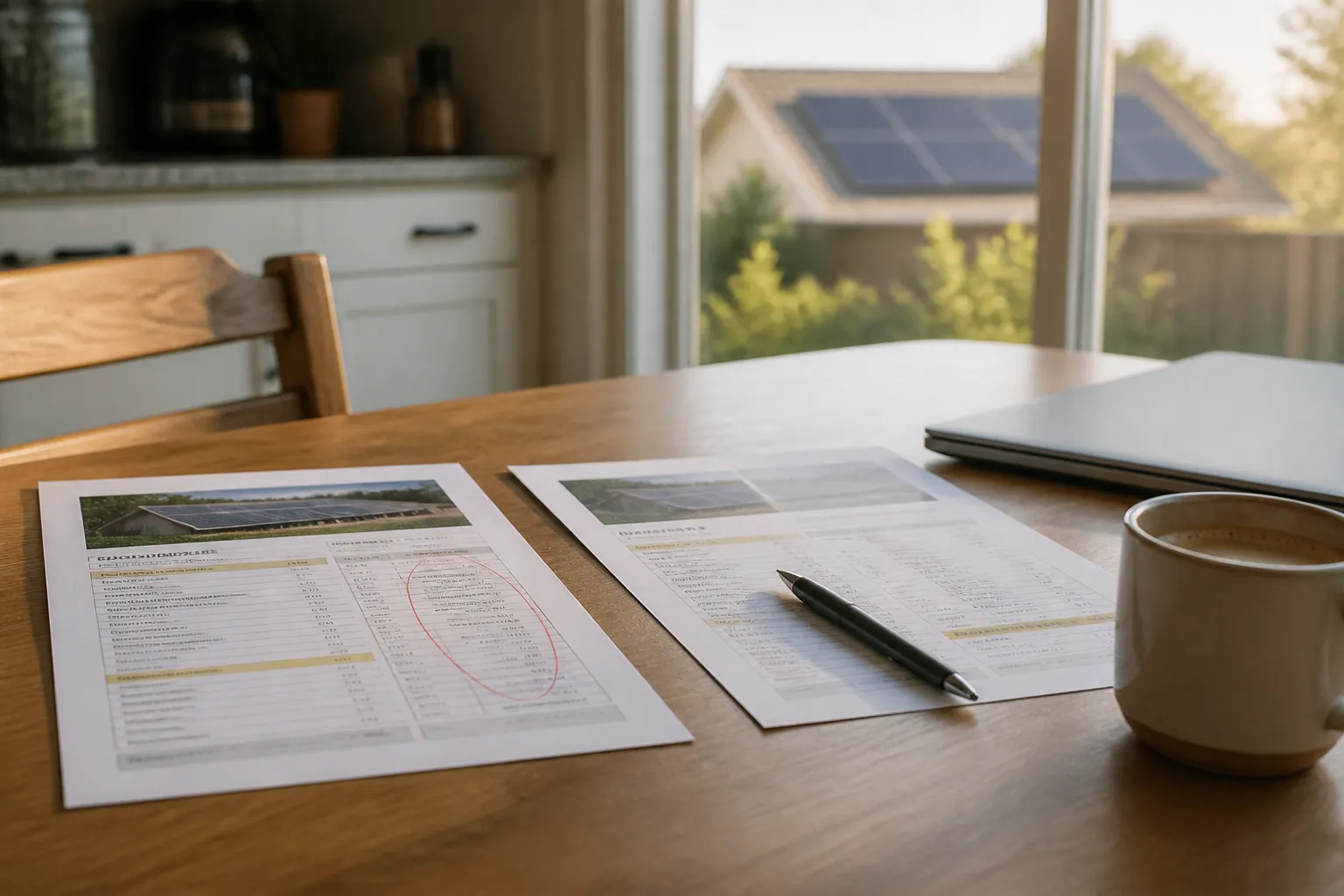
When quotes arrive, ask every installer for the same breakdown in writing:
- Equipment (panels, inverters, any battery)
- Labor and installation
- Permits and utility interconnection
- Electrical panel or roof work, if needed
With that list, bids using different system sizes and brands become comparable. Without it, you are comparing marketing.
How the federal tax credit change affects your net cost
This is the biggest recent shift for anyone pricing a purchased system. According to EnergySage, the One Big Beautiful Bill Act, passed in July 2025, eliminated the 30% federal tax credit for purchased residential solar systems installed after December 31, 2025. The sticker price may look the same as last year, but the net price is a different story.
EnergySage also reports that homeowners rushed to install before the deadline, one of the largest demand surges the industry has seen. A surge like that can stretch schedules and change how installers price. Since today is May 28, 2026, the deadline has passed, so a quote that quietly assumes the credit deserves a hard look.
Ask each installer two things: does this quote assume the credit, and what changes if it does not apply to my installation date? Then take the answer to a licensed tax professional, who can tell you how the rules apply to your situation.
How to check an installer's credentials
The North American Board of Certified Energy Practitioners, known as NABCEP, runs an online Professional Directory. You can search by name or certification number and filter for local professionals. Each listing shows the credential type and an expiration date for that person.
Here is the order I would follow:
- Get the installer's name and NABCEP certification number in writing.
- Search the directory and confirm the listing matches.
- Check the expiration date. If it has lapsed, ask for current proof.
- Read the credential type. A PV Installation Professional (PVIP) is tied to installation, a PV Design Specialist (PVDS) to system design, and a PV Associate (PVA) is entry level.
- Confirm the person who will design or install your system holds the credential that fits that work.
One caution. NABCEP certification is not the same thing as a state license. The sources here do not explain how the two interact, so check separately whether your state or city requires a contractor or electrical license, and whether the installer holds it.
Questions to ask and red flags to watch for
Bring a short script to every sales visit. It keeps the conversation on your terms, and a good installer will not mind.
- What is your NABCEP certification number, and when does it expire?
- Is the person visiting my home the same person listed in the directory?
- Does your quote account for the federal credit ending for systems installed after December 31, 2025?
- How are tariffs and equipment supply affecting your timeline and price?
That last question matters because EnergySage's 2025 report describes shifting federal policy, tariffs, and tighter trade restrictions as headwinds installers already feel, with possible effects on how projects are financed, supplied, and built.
On the warning side, the Federal Trade Commission has documented solar and clean energy scams. Be wary of unsolicited offers, pressure to sign today, and anyone who cannot produce a certification number or whose name is missing from the directory. Verify further before you commit.
Finally, get the contract in writing and read it slowly. Look for the total price, payment schedule, warranty terms, and who handles permitting, interconnection, and inspection. The sources here do not cover those terms in detail, so ask the installer to explain each one and compare against your local requirements.
Where to find more information and what this guide does not cover
Government pages are a good next stop. The FTC's consumer advice covers buying solar and avoiding scams, and the Department of Energy offers a homeowner's guide to solar and a page of system cost benchmarks. I could not pull the benchmark figures for this guide, so check that page directly for current numbers. You can also run the credential check yourself in the NABCEP Professional Directory.
This guide does not cover financing, leases, or power purchase agreements, state or utility rebates beyond the federal credit, or how to look up complaint history. Your state consumer protection office or licensing board can help with licensing and complaints before you pick an installer.
This is general information, not personal financial, tax, or legal advice. Before committing, talk with a licensed tax professional about the credit, and with a qualified professional about your roof, electrical service, and local permits.
Sources
- Solar Power for Your Home | Consumer Advice
- How to avoid getting burned by solar or clean energy scams | Consumer Advice
- Homeowner’s Guide to Solar | Department of Energy
- https://vertexaisearch.cloud.google.com/grounding-api-redirect/AUZIYQHlPxbM8QNKc3R6fw3yEk4nnTmtCnRQgq_omEbZMAPiI_grmokBnFtjICixU0iBmN1lDc2ziImYI3P4tbezIS0FQoDcj7T8OEBO_9aBu1dBVG-z9FnGORhfIPoJ0u_0MR2QbJWusTArQsLW2C6Phmu6rveg0ravqTJYN3NlWqTZtgCuQlD2MADrYTuqBnLmRtA97_gWfdeff0owPjbPLZWWdgCL-Mk2eCPhVPOMm_bD3KYluB8M_qSNyrKi2hA=
- Solar Photovoltaic System Cost Benchmarks | Department of Energy
- NABCEP Professional Directory - NABCEP
- EnergySage Releases 21st Solar & Storage Marketplace Report, Reflecting H1 2025 | EnergySage
- EnergySage Marketplace Report Shows Incentive Expiration Triggered Historic Shift in Home Energy Market | EnergySage
Still have a question?
Related guides
-

Upgrading to 200 Amps Without the Surprise Bill
Panel costs are only part of the story, so here is what a 200 amp upgrade typically runs, what can get added on, and what to ask before you sign. By Neil Ostrander
-

Tank or Tankless? How to Compare Water Heater Bids on Equal Terms
Learn how tank and tankless units differ, and which details a written plumber's quote should spell out so three bids can be compared fairly.By Renata Okafor
-

Find the Water First: A Practical Guide to Deciding on Mold Testing and Cleanup
Before anyone runs a sample or quotes a job, the moisture source and the size of the visible patch settle most of the decision. By Gideon Aldaine